Layover Pay in Trucking: A Guide for Carriers & Dispatchers
Layover pay in trucking for owner-operators and dispatchers: what brokers pay per day, when it starts, and 6 steps to get it written on the rate con.

Co-Founder
Co-Founder of LoadConnect specializing in AI dispatch software, freight operations, carrier growth, broker verification, and logistics automation.
39 published articles

Layover pay in trucking for owner-operators and dispatchers: what brokers pay per day, when it starts, and 6 steps to get it written on the rate con.

How to negotiate freight rates with brokers as an owner-operator or truck dispatcher: know your minimum, counter with a reason, get it on the rate con.

Reefer rates are up 34% and produce lanes are jumping. Before you reposition a truck, use a rate per mile calculator to compare true RPM and profit per day.

Spot rates are up, but so are diesel, insurance and tolls. A truck dispatcher's playbook for 2027: true rate per mile, fuel surcharge, broker credit check.

Quick answer: Carrier identity theft happens when a fraudster impersonates a legitimate trucking company by using its MC number, USDOT number, company name, documents, contact information, or other business credentials. A carrier lookup may show a real, active company even when the person trying to book the load has no connection to it. To detect stolen carrier identities, brokers need to verify that the regulatory record, contact information, documents, dispatcher, driver, and equipment all poi

Finding freight is only the first part of the dispatch workflow. The best load boards for truckers help carriers and owner-operators discover available loads, compare lanes, review rate or broker information, and connect with brokers quickly. But different platforms are better suited to different fleet sizes, equipment types, lanes, budgets, and operating styles. There is no single load board that is best for every carrier. DAT is a strong choice for broad freight coverage and market data, Truc

Verifying a trucking company is no longer just a matter of checking whether an MC or USDOT number exists. Brokers need to confirm that the carrier is authorized for the work, has appropriate insurance information on file, shows a safety record that matches the risk profile of the load, and is actually the company represented in the email, phone call, or carrier packet. This article focuses on the verification workflow and tools used to confirm a trucking company’s identity and operating informa

Quick answer: "Works with DAT and Truckstop" can mean very different things depending on the tool. A true integration requires a formal agreement with each board - DAT through its Developer Portal and rep approval, Truckstop through a signed Systems Integration Agreement and often a Load Board Pro subscription - while other tools operate as browser extensions that work directly on the load board interface without that backend integration. Neither approach is automatically better; they solve diff

Quick answer: Before booking a carrier, brokers should verify active FMCSA operating authority, underlying safety data, required insurance coverage, identity consistency, authority age, complete carrier packet documentation, out-of-service rates versus relevant benchmarks, fraud and double-brokering signals, references, and ongoing re-verification. A May 2026 Supreme Court ruling made documented, reasonable carrier selection more important than ever for brokers defending against negligent-select

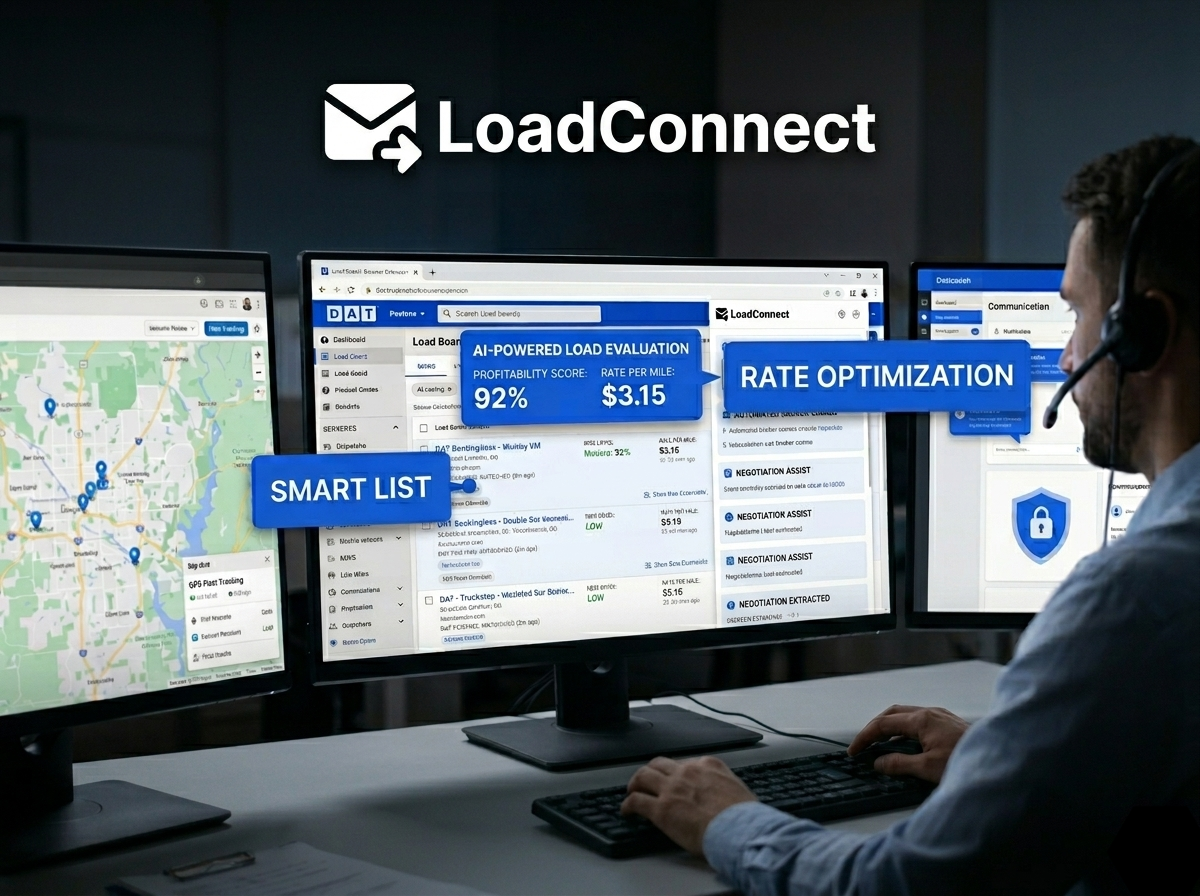
Quick answer: An AI Dispatch Assistant is software that uses artificial intelligence to help truck dispatchers evaluate loads, verify brokers, calculate real profitability, and read documents like rate confirmations - automating the research and calculation work while the dispatcher makes the final booking decision. Tools in this category, such as LoadConnect, typically run as a browser extension on top of load boards like DAT and Truckstop and can cut manual dispatch work by roughly half. Mode

Quick answer: The biggest broker-related threats to carriers and dispatchers in 2026 include double brokering, broker impersonation, non-payment, rate confirmation fraud, phishing, and identity theft. The FBI reported that estimated cargo theft losses across the United States and Canada reached nearly $725 million in 2025, up 60% year over year. Verifying a broker’s authority, payment history, contact identity, and load documents before booking has become a critical part of freight risk manageme

Quick answer: DAT, Truckstop, and Loadlink (Canada-only) are the three load boards that matter most for spot freight in North America. DAT has the largest volume and deepest rate data; Truckstop leads in flatbed/hot shot freight and instant booking. For dispatchers using any of these boards, LoadConnect adds AI-powered broker verification, fraud alerts, one-click communication, and rate calculation directly on top - cutting manual work by roughly 50% for the 15,000+ trucking companies already us

In today’s freight market, trust has become one of the industry’s most valuable currencies. As freight fraud, double brokering, cargo theft, and compliance concerns continue to rise across the transportation industry, brokers are becoming increasingly selective about the carriers they choose to work with. Load boards alone are no longer enough to win quality freight opportunities. Brokers want confidence that the carriers they partner with are reliable, compliant, and reputable. The challenge

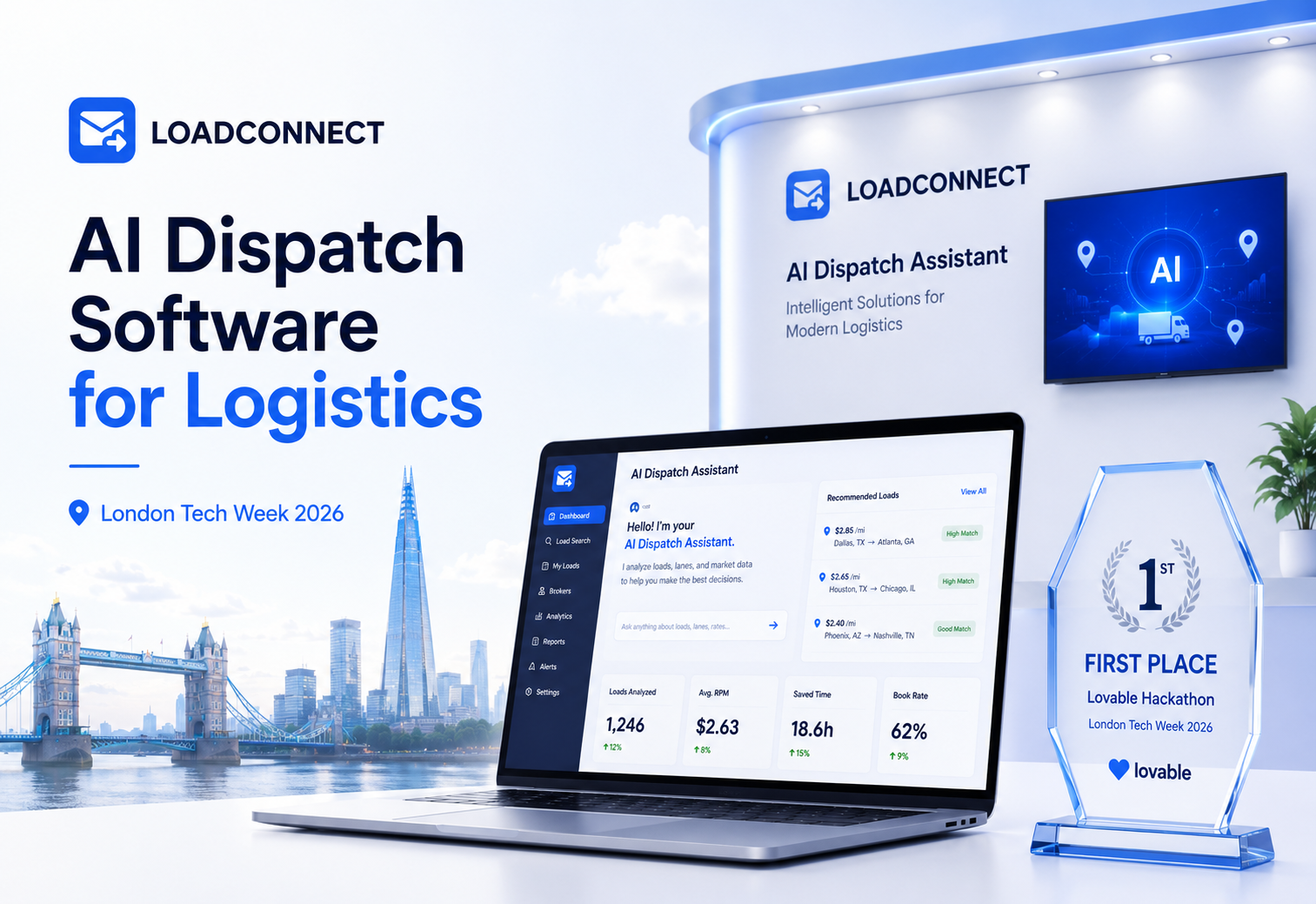
LoadConnect participated in London Tech Week 2026, one of the world's largest technology events, bringing together leading companies, startups, investors, engineers, and innovators from across the global tech ecosystem. As part of the High Technology Park of the Kyrgyz Republic delegation, the company showcased its AI-powered Dispatch Assistant, demonstrating both practical AI solutions for the transportation industry and the growing technological capabilities of Kyrgyzstan. This year's London

Most dispatchers rely on platforms like DAT Load Board and Truckstop Load Board as their primary source of freight. These platforms provide access to available loads, but they do not solve the main challenge in modern dispatching. The real bottleneck is not freight availability, but evaluation - determining which loads are actually worth taking under time pressure. High-paying loads are not identified by increasing search effort, but by improving filtering and speeding up decision-making. In

Truck Drivers Are Looking for More Than Just “Any Job” The trucking industry has become extremely competitive, and today’s drivers are being far more selective about where they work. Instead of simply searching for “truck driving jobs near me,” many CDL drivers are now searching for higher paying trucking jobs, local CDL jobs with weekends off, dedicated lane opportunities, regional trucking jobs with home time, owner operator opportunities, and companies with newer equipment and stable freight

What Mistakes Do Dispatchers Commonly Miss in Rate Confirmations? The most common rate confirmation mistakes include missed appointment changes, hidden detention requirements, overlooked TONU conditions, unexpected cargo requirements, additional equipment obligations, modified payment terms, and broker information discrepancies. These issues often appear in the fine print of a rate confirmation and can lead to unpaid accessorials, reduced profitability, operational delays, cargo disputes, or ev

AI dispatch software is transforming how trucking companies discover freight, evaluate opportunities, communicate with brokers, manage capacity, and make operational decisions in real time. Instead of relying on spreadsheets, manual calculations, multiple browser tabs, and disconnected communication channels, dispatch teams increasingly use software designed to structure information, surface better opportunities, and reduce the time required to make high-quality decisions. However, the term "A

Every few weeks, a new AI company announces another breakthrough. AI agents can now book loads, communicate with brokers, analyze freight opportunities, and perform tasks that recently required human involvement. As a result, the conversation around artificial intelligence in trucking has evolved. A few years ago, most discussions focused on efficiency and automation. Today, carriers are asking a different question: how much access should AI actually have? Can AI dispatch software help dispatc

Not long ago, the hardest part of trucking was finding freight. Today, that problem has largely disappeared. Modern trucking load boards, broker platforms, and digital freight marketplaces are flooded with available loads, with new postings appearing every second across major freight load boards. Carriers, dispatchers, and owner-operators now have more access to freight than at any point in industry history. And yet profitability remains unstable. The reason is simple: freight access increase

Freight is everywhere. Profitability isn’t. The problem in trucking today is no longer finding loads - it’s deciding which ones actually make money. The U.S. trucking industry is entering a phase where market growth no longer guarantees operational stability. Freight volumes continue to rise, but so does complexity - more loads, more platforms, more real-time decisions, and more pressure on dispatch teams. At first glance, this should make operations easier. In reality, it does the opposite:

Most dispatchers don’t lose money on bad loads. They lose it on loads that look good at first glance. In today’s market, access to freight is no longer the problem. Load boards are full, capacity is available, and options are everywhere. Yet consistent performance is still hard to achieve. The constraint has shifted - from access to decision quality under time pressure. The real problem in modern dispatching Every day, dispatchers operate in a high-frequency environment: * monitoring loa

Modern logistics has become fully digital. What used to be phone calls, spreadsheets, and manual coordination is now managed through cloud platforms and specialized tools that power the entire flow of freight operations. Today, most dispatch teams work directly inside browser-based environments, relying on load boards, rate tools, carrier databases, and financial platforms to keep operations moving. As a result, modern trucking dispatch software is no longer just a back-office system - it has b

The freight industry in 2026 looks very different from just a few years ago. The market of freight brokerage companies has grown rapidly, driven by global supply chain expansion, e-commerce demand, and increasing pressure on delivery speed and cost efficiency. At the same time, competition among freight broker companies has intensified significantly, making it harder for shippers and carriers to identify truly reliable partners. One of the biggest shifts in recent years is the level of automati

Modern trucking operations don’t struggle because of a lack of effort - they struggle because of how the work is structured. Dispatchers today are expected to manage everything at once: searching load boards, calling brokers, sending emails, tracking updates, and making fast decisions under pressure. Even with existing trucking dispatch software, much of the day is still spent switching between tabs, repeating the same actions, and manually evaluating options. A significant portion of a dispatc

Recent freight rate trends are increasingly influenced by one key factor - rising diesel fuel prices across the United States. According to the U.S. Energy Information Administration (EIA), the national average on-highway diesel price reached approximately $5.375 per gallon as of the March 23, 2026 weekly update, reflecting a noticeable increase compared to earlier in the month. While the increase is significant, it is important to frame it accurately. On March 9, 2026, the national average sto

In 2025-2026, logistics is no longer just about moving goods from point A to point B - it has become a complex ecosystem involving numerous participants. From ltl trucking companies managing partial loads, to specialized heavy haul trucking companies, versatile flatbed trucking companies, and temperature-sensitive refrigerated trucking companies, every segment introduces unique challenges and potential risks. The more actors involved in a supply chain, the more potential failure points emerge.

In today’s fast-paced freight industry, email is the primary hub of communication between brokers and carriers. Critical operational decisions - such as assigning a load to a reliable carrier - often happen directly within the inbox. However, a key step in this workflow, MC number verification, has traditionally occurred outside the email environment, forcing brokers to juggle multiple platforms, including load boards, FMCSA databases, and spreadsheets. This article explores the growing industr

In the trucking industry, a rate confirmation (RC) is far more than a routine document - it is the formal agreement that sets the financial and operational terms for a shipment. A single carrier rate confirmation or broker rate confirmation serves as the cornerstone for revenue calculation, route planning, and compliance verification. Getting it right is essential for protecting your margins, ensuring accurate Revenue per Mile (RPM), and minimizing costly empty miles, or deadhead. Errors in rat

In today’s freight industry, dispatchers play a central role in keeping supply chains moving. They coordinate trucks, evaluate loads, negotiate rates, communicate with brokers, and ensure that drivers operate efficiently across constantly changing market conditions. A single decision - accepting or rejecting a load - can significantly affect profitability, driver utilization, and overall fleet performance. The economics of trucking remain extremely tight. According to the American Transportatio

For small and mid-sized carriers, the economics of trucking have never been tighter. Margins are thin. Rates are volatile. Operating costs continue to rise. And the margin for error? Almost nonexistent. Fuel prices fluctuate. Insurance premiums climb. Equipment financing costs remain high. Meanwhile, spot rates can shift dramatically from week to week, making revenue forecasting increasingly unpredictable. In this environment, traditional trucking dispatch built on spreadsheets, phone calls, an

The U.S. trucking industry in 2026 is more competitive, more digitized, and more complex than ever. With over 750,000 active motor carriers operating nationwide and freight volumes steadily shifting between truckload and less-than-truckload networks, choosing the right partner is no longer a simple decision. Capacity cycles, regional LTL expansion, stricter compliance oversight, rising insurance costs, and rapid adoption of freight technology have reshaped what it means to be a “top” carrier. S

Getting paid for the loads you haul should be predictable — not a roll of the dice. Yet many trucking companies don’t realize how much financial risk they’re accepting until an invoice goes unpaid. One of the biggest factors determining who absorbs that loss is whether you use recourse or non-recourse freight factoring. At a high level, recourse factoring offers lower fees but places the risk of nonpayment on the carrier. Non-recourse factoring costs slightly more but shields your business if a

The role of a truck dispatcher has become increasingly complex over the past few years. Where the core skill used to be simply “finding a good load and negotiating it,” today’s dispatchers face far more demanding conditions. Modern dispatching requires managing intense competition, tight decision windows, and a constant flow of information that must be processed in real time. On popular load boards, the number of dispatchers vying for the same load has multiplied. Good rates are snapped up with

Freight workflows for carriers and dispatchers are becoming increasingly complex as the market grows faster and more fragmented. Today, booking even a single load often requires navigating multiple tools simultaneously: load boards, email, FMCSA databases, mapping services, spreadsheets, and internal notes. Each step is critical for accuracy and efficiency. However, manual handling often creates bottlenecks, slows decision-making, and increases the risk of costly errors. Teams frequently spend

Here’s a proven approach: 1. Search auctions first, not dealerships 2. Research past sale prices for similar trucks 3. Set a firm max bid before the auction starts 4. Factor inspections and transport costs 5. Bid based on data, not emotion Tools like BidAgent exist for one reason: to help buyers avoid expensive mistakes and consistently buy below market value. Final Thoughts: Cheap Trucks Still Exist — If You’re Prepared Yes, you can buy cheap trucks in 2026 — but only if you a

The trucking industry is changing fast — and so is dispatching. Today, successful truck dispatchers aren’t just booking loads. They understand lanes, rates, broker behavior, carrier protection, and how to use technology to move trucks profitably. That’s why enrolling in a dispatch training course has become one of the smartest career moves in trucking. Why Most New Dispatchers Struggle Without Training Many people enter dispatching thinking it’s easy money. The reality is very different.

Dispatching today isn’t about finding any load — it’s about booking the right load, from the right broker, at the right rate, faster than the competition. That’s exactly why LoadConnect exists. 👉 Install the LoadConnect Chrome Extension (Free) LoadConnect - Chrome Web Store LoadConnect is a Chrome extension built specifically for real-world dispatchers who need speed, accuracy, and structure while booking loads every single day. The Real Problem Dispatchers Face Most dispatchers deal

The integration empowers carriers with instant broker verification, enhanced transparency, and secure automated dispatch operations. LoadConnect, a leading provider of automated freight dispatch technology, has announced a strategic partnership with OTR Solutions, a logistics-focused financial and technology company recognized for its trusted credit intelligence and factoring services. This partnership enables OTR’s verified broker credit data to be directly integrated into the LoadConnect pla