AI in Trucking: How Freight Dispatch Software and AI Dispatch Systems Are Transforming Decision-Driven Dispatch
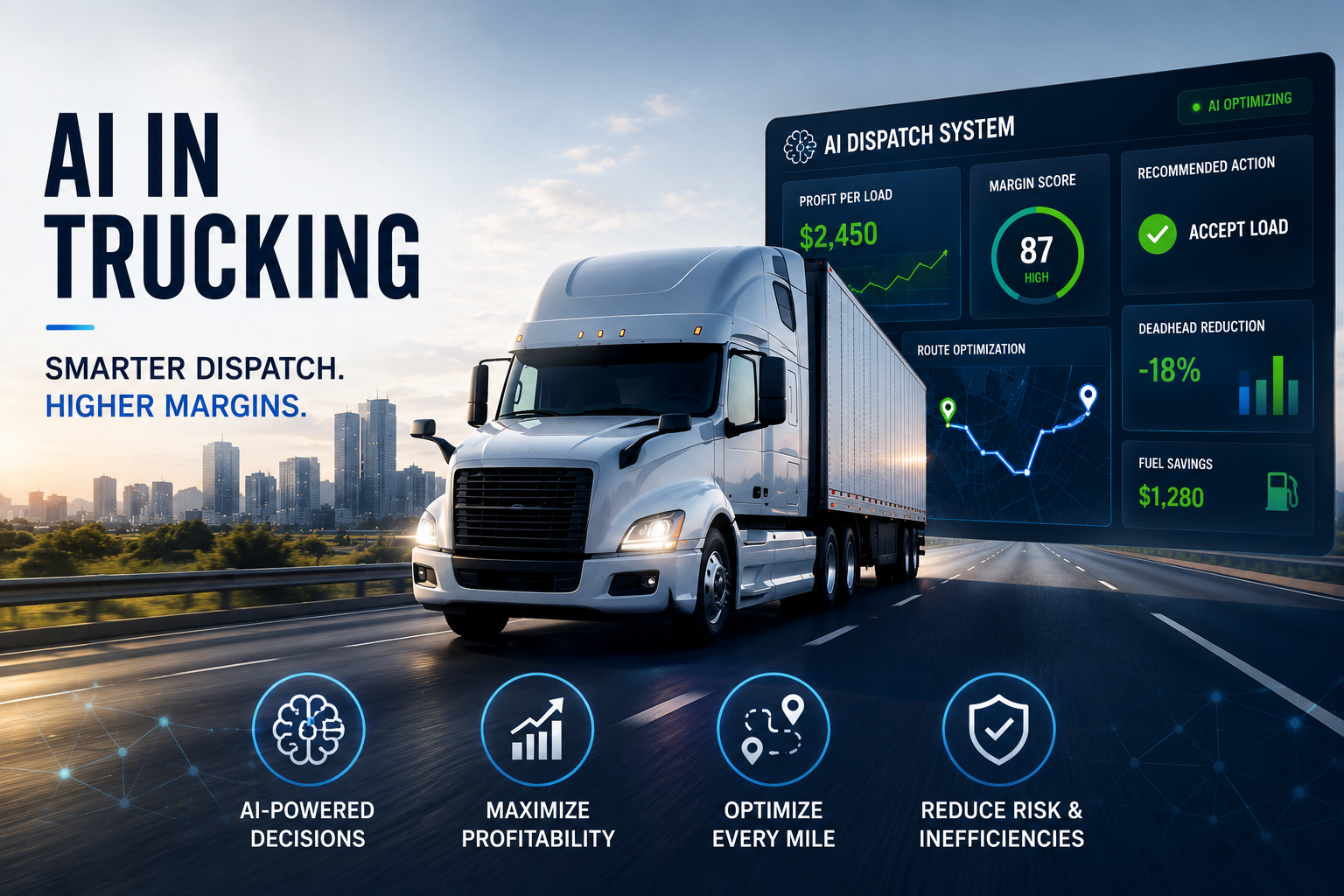
Freight is everywhere. Profitability isn’t.
The problem in trucking today is no longer finding loads - it’s deciding which ones actually make money.
The U.S. trucking industry is entering a phase where market growth no longer guarantees operational stability. Freight volumes continue to rise, but so does complexity - more loads, more platforms, more real-time decisions, and more pressure on dispatch teams.
At first glance, this should make operations easier. In reality, it does the opposite: increased choice creates decision overload, and profitability becomes harder to maintain consistently.
Today, competition between small fleets and large carriers is no longer defined only by fleet size. It is defined by how quickly and accurately companies can make decisions under pressure. Large carriers win not because they have more trucks, but because they operate with more structured systems for decision-making, data interpretation, and cost control.
This is where traditional models of freight dispatch begin to break down. What once worked - manual load selection, experience-based dispatching, and reactive planning - is no longer enough in a market where decisions must be made in seconds, not hours.
Most operations still rely on legacy approaches powered by trucking dispatch software and basic dispatch software for trucking, which were designed to organize workflows rather than optimize financial decisions in real time.
As a result, a critical gap is emerging:
- The market is accelerating
- Decision-making models are not evolving at the same speed
- Margin loss happens not from lack of freight, but from suboptimal decisions under pressure
Even modern dispatch software, including dispatching software used by many fleets today, often focuses on operational visibility rather than economic intelligence. This limits its ability to support real-time profitability decisions.
This gap between speed and decision quality is now one of the main factors separating fast-growing trucking companies from those struggling to maintain stable margins.
Top Trucking Companies: What Fast-Growing Carriers Have in Common
Leading U.S. Carriers and Their Operational Advantage
| Company | Operational Edge | What Drives Growth |
|---|---|---|
| Knight-Swift Transportation | Network optimization, centralized dispatch, cost control | Systemized execution replaces fragmented decisions |
| J.B. Hunt Transport Services | Digital freight ecosystem, analytics, automated load allocation | Data-driven dispatch instead of manual evaluation |
| Schneider National | Real-time visibility, workflow automation, empty mile reduction | Faster and more consistent operational decisions |
| Covenant Logistics | Standardized dispatch and scalable processes | Reduced dependency on individual dispatcher judgment |
| Werner Enterprises | Route optimization and performance tracking | Continuous fleet utilization optimization |
| Landstar System | Platform-based load matching and agent network | Scales through platform intelligence |
| Old Dominion Freight Line | Highly optimized LTL operations and terminal efficiency | Operational consistency across the network |
| XPO Logistics | AI-supported routing, freight matching, analytics | Technology-enabled large-scale decision-making |
What They All Have in Common
Despite differences in scale and business models, these companies operate on the same principles:
- Reduced reliance on manual dispatch decisions
- Heavy investment in structured systems and data
- Consistency over one-off optimization
- Ability to scale decision-making - not just fleet size
The key shift:Growth is no longer driven by access to freight. It is driven by the ability to make better decisions - faster and more consistently under pressure.
Why Large Carriers Win (and Why It’s Not About Size)
Most people assume large carriers win because they have more trucks. They don’t.
They win because they make better decisions - faster, and more consistently - across thousands of loads every day.
Size scales operations. Systems scale decisions.
They Don’t See More Data - They See the Right Data
In small fleets, dispatchers often make decisions with incomplete context: a rate, a distance, a deadline.
Large carriers operate differently.
They evaluate every load with full operational visibility:
- real cost per mile
- network position of the truck
- downstream routing impact
- current and predicted market conditions
This is not just “more data.” It’s decision-ready context.
They Don’t Automate Tasks - They Automate Decisions
Most dispatch tools help execute decisions. Large carriers build systems that make decisions before humans do.
Instead of manually reviewing every option, they:
- filter out low-margin loads automatically
- apply standardized decision rules across the fleet
- remove variability from dispatcher judgment
This eliminates one of the biggest hidden risks in trucking: inconsistent decision quality under pressure.
They Optimize for Margin, Not Movement
Smaller fleets often optimize for:
- keeping trucks moving
- maximizing RPM
Large carriers optimize for something else: total network profitability.
That means:
- reducing empty miles before they happen
- positioning trucks for the next load, not just the current one
- aligning dispatch decisions with long-term network efficiency
A load is not evaluated in isolation - it is evaluated as part of a system.
They Use AI as an Operational Layer, Not a Feature
AI in trucking is often misunderstood as automation. For large carriers, it functions differently: it is part of the decision-making infrastructure.
They use it to:
- predict load profitability before acceptance
- model routing efficiency in real time
- detect risk (delays, weak lanes, margin erosion)
- support pricing and allocation decisions dynamically
These are not standalone tools. They are interconnected decision systems.
The Real Advantage: Systemized Intelligence
What truly separates large carriers is not scale, technology, or access to freight.
It is this: their decision-making is embedded into the system - not left to individuals.
This creates a compounding effect:
- faster decisions under pressure
- consistent outcomes across thousands of loads
- lower margin volatility
- scalable operational control
What This Means in Practice
A dispatcher in a small fleet might have 30–60 seconds to evaluate a load.
A dispatcher in a large carrier doesn’t start from zero. They start from a pre-evaluated decision.
That difference - multiplied across hundreds of decisions per day - is where the margin gap is created.
Bottom Line
Large carriers don’t win because they operate more.
They win because: they operate on systems that make better decisions than humans can under pressure
The Core Problem Small Trucking Companies Face
While large carriers are scaling through systems and technology, most small and mid-size trucking companies are struggling with a very different reality - not lack of freight, but lack of structured decision-making capacity.
The issue is not operational effort. It is the absence of scalable decision systems that can support dispatch under constant time pressure.
Limited dispatcher capacity
In most small fleets, dispatching is handled by a very small team - sometimes even a single person managing dozens of moving variables at once.
This creates a structural limitation:
- too many loads to evaluate in real time
- too little time per decision
- high dependence on individual experience
As a result, dispatch quality becomes inconsistent, especially during peak activity.
Manual decision-making under pressure
Despite access to modern tools, many small fleets still rely on manual decision processes when selecting loads.
Typical workflow looks like:
- checking load boards manually
- comparing rates without full cost breakdown
- making decisions under broker time pressure
Even when dispatch software is used, it is often limited to visibility and coordination rather than decision optimization.
Margin loss at the load level
Even small inefficiencies at the load level - when repeated across hundreds of dispatch decisions per month - can translate into significant cumulative margin erosion over time. The impact is not always visible in single transactions, but becomes clear at the fleet level.
The biggest financial issue does not appear in large operational failures - it appears in small, repeated inefficiencies.
Common examples include:
- underestimated deadhead distance
- overreliance on RPM as a single metric
- incomplete cost evaluation per load
Individually, these decisions seem acceptable. But across hundreds of loads, they create significant margin leakage that directly impacts profitability.
Lack of system-level analytics
Most small fleets do not operate with structured analytics across their dispatch process.
Instead of system-driven insights, decisions are based on:
- experience of the dispatcher
- short-term availability of freight
- immediate cash flow needs
Even when using dispatch software for trucking or basic truck dispatching software, the focus is usually on operational tracking rather than financial decision intelligence.
The structural gap
The core issue is not effort or motivation. It is the absence of a system that can:
- standardize decision-making under pressure
- evaluate full-trip economics in real time
- reduce dependency on manual judgment
Without this layer, dispatching remains reactive rather than strategic - and small inefficiencies accumulate into long-term margin erosion.
This is where the gap between small fleets and large carriers continues to widen.
How Small Trucking Companies Can Compete with Large Carriers
Small and mid-size fleets cannot compete with large carriers by copying their scale. They compete by improving decision quality and reducing inefficiencies at the operational level. The key shift is from manual dispatching to system-supported decision-making.
Automating Dispatch Operations
One of the fastest ways small trucking companies can improve competitiveness is by reducing dependency on manual dispatch decisions.
In high-pressure environments, human judgment becomes inconsistent. Automation helps stabilize decision quality and speed.
Modern ai dispatcher solutions are designed to:
- reduce human error in load selection
- speed up dispatch decision cycles
- standardize how loads are evaluated
Instead of relying on reactive decision-making, companies can move toward structured workflows supported by ai dispatch systems and ai dispatch software.
This does not replace dispatchers - it removes repetitive cognitive load, allowing them to focus on exceptions rather than routine decisions.
Using AI for Decision Intelligence, Not Just Load Search
Traditional dispatching focuses on finding available loads. However, real competitiveness comes from evaluating the economic quality of each load before execution.
This is where AI changes the model.
With ai truck dispatcher systems and dispatch ai tools, companies can move from simple load visibility to decision intelligence, including:
- evaluating expected profitability per load
- assessing risk before execution
- identifying weak-margin opportunities early
This introduces the concept of predictive margin evaluation - where decisions are guided not only by current rates, but by expected financial outcomes.
Instead of reacting to available freight, dispatch becomes a proactive optimization process.
Optimizing Every Load, Not Just Finding Loads
Most small fleets focus heavily on load acquisition. However, profitability is often determined after a load is accepted - not before.
True optimization requires full-cost evaluation of every trip, including:
- deadhead distance
- fuel consumption
- total miles driven
- real operational margin per load
Without this layer, even high-rate loads can lead to weak profitability.
Modern freight dispatch software and dispatch trucking software increasingly support this shift by enabling full-trip economic visibility instead of surface-level rate comparison.
The key difference is simple:
- Traditional approach: “Is this load available and well-paid?”
- Modern approach: “What is the true margin after all costs are considered?”
The Competitive Shift
Small trucking companies can compete effectively when they move from manual dispatching to system-driven decision-making.
The winning model is no longer based on access to freight, but on the ability to:
- automate routine dispatch decisions
- evaluate load profitability in real time
- optimize every mile, not just every load
This is where AI and modern dispatch systems create a structural advantage that is no longer dependent on company size.
What Is an AI Dispatcher and How LoadConnect Is Changing the Market
The trucking industry is moving toward a new operational layer where dispatching is no longer just about managing loads - it is about making consistently correct financial decisions in real time. This is where the concept of an ai dispatcher becomes practical, not theoretical.
LoadConnect is built around this shift. Instead of acting as a traditional dispatch tool, it functions as a decision layer inside dispatch operations.
From dispatch tool to real-time decision layer
In traditional systems, dispatchers collect information, compare loads, and make decisions manually under time pressure.
With LoadConnect, this structure changes.
The system operates as a real-time decision layer that continuously evaluates operational signals, including:
- true load profitability after full costs
- deadhead impact and total trip economics
- fuel and route-level efficiency
- margin risk under current conditions
Instead of starting from raw data, dispatchers start from interpreted decisions.
This is the key difference between standard ai dispatch tools and LoadConnect - it does not show information, it translates it into action-ready direction.
Reducing cognitive load in dispatch operations
One of the biggest operational challenges in trucking is cognitive overload. Dispatchers are forced to evaluate multiple loads, broker requests, and timing constraints simultaneously - often under strict time pressure.
LoadConnect reduces this load by removing repetitive financial calculations from the decision process.
The system:
- pre-evaluates load economics in real time
- highlights only decision-relevant options
- removes the need for manual recalculation
- standardizes how profitability is assessed across teams
As a result, dispatchers are no longer constantly calculating - they are making decisions based on structured intelligence.
This is where ai dispatcher functionality becomes operational, not just supportive.
From data visibility to decision readiness
Most systems in ai trucking and dispatching still focus on visibility - showing rates, miles, and available loads.
LoadConnect goes one level deeper.
It converts raw operational data into decision-ready meaning:
- “below target margin” instead of just rate and miles
- “high deadhead exposure” instead of isolated distance data
- “weak profitability lane” instead of generic load availability
This shift removes interpretation from the dispatcher’s workload and replaces it with clear decision context.
How LoadConnect changes dispatch decision-making
With LoadConnect, dispatching is no longer a manual evaluation process for every load. Instead, it becomes a structured decision flow where the system continuously supports prioritization.
The dispatcher no longer asks: Is this load good?
They work with pre-processed decision intelligence: Is this load worth taking given full operational context?
This is where ai dispatch becomes meaningful - not as automation, but as decision guidance under pressure.
Companies Already Using LoadConnect (Operational Adoption Signal)
Real market validation of dispatch technology is not defined by positioning - but by adoption inside live fleet operations. Below are carriers already using LoadConnect across different operational scales.
| Segment | Company | Operational Challenge | How LoadConnect Is Used | Core Impact |
|---|---|---|---|---|
| Small Fleets (high dependency on dispatch efficiency) |
CARDENAS TRUCKS CORP MC906415 |
Limited dispatcher capacity High pressure per decision Inconsistent load evaluation |
Real-time load profitability evaluation Decision standardization under time pressure |
More consistent margins per load Reduced reliance on manual judgment |
| MEGA TRANS GROUP LLC MC021602 |
Same constraints: small team, high variability in decisions |
Structured decision workflows Automated economic assessment per load |
Lower decision variability Improved daily profitability stability | |
| Mid-Size Carriers (scaling complexity) |
STRAIGHT FREIGHT LTD MC1636405 |
Scaling dispatch without losing control Multiple dispatchers, inconsistent decisions |
Standardized load evaluation across teams Centralized decision logic |
Consistency across dispatch operations Reduced margin volatility |
| CASSIDY'S TRANSFER & STORAGE LIMITED MC250053 |
Increasing operational complexity Fragmented decision-making across routes |
Load prioritization based on full-trip economics Cross-team decision alignment |
Improved coordination More predictable route-level margins | |
| High-Volume Operators (time-sensitive environments) |
GALAXY FREIGHTLINE INC MC662489 |
High-frequency decisions Extreme time pressure Need for fast load acceptance |
Real-time filtering of low-margin loads Priority-based decision support |
Faster, more accurate decisions Reduced cognitive overload during peak cycles |
Importantly, LoadConnect does not replace existing dispatch systems. It operates as an additional decision layer that enhances how existing freight dispatch software is used in practice - improving consistency and financial accuracy in dispatch decisions.
Why the Market Shift Is Happening Now
The trucking industry is not changing randomly - it is reaching a structural breaking point where traditional decision-making can no longer support operational pressure.
Three forces are accelerating this shift at the same time:
Rising cost of dispatching mistakes
Every incorrect dispatch decision now has a direct financial impact. Fuel volatility, tighter lanes, and unstable rates mean that even small errors in load selection quickly turn into margin loss.
What used to be “acceptable inefficiency” is now a measurable profit leak.
Continuous pressure on margins
Margins across trucking operations are becoming thinner and more sensitive to operational decisions. This makes consistency more important than occasional high-performance decisions.
In this environment:
- one bad load can offset several good ones
- small inefficiencies accumulate faster
- optimization matters at the individual load level
This is why ai in trucking is no longer a future concept - it is becoming an operational necessity.
Lack of time for decision-making
Dispatchers today operate in a compressed time environment:
- loads expire in minutes
- brokers expect instant responses
- drivers depend on immediate coordination
This eliminates the possibility of deep manual analysis for every decision. As a result, decisions are increasingly based on shortcuts rather than full economic evaluation.
Transition to AI-driven systems
The industry is now moving toward trucking AI and structured intelligence systems that can support or automate parts of decision-making.
This includes:
- real-time load evaluation
- predictive margin analysis
- automated filtering of low-value opportunities
- decision support under time constraints
The rise of ai applications trucking is not about replacing dispatchers - it is about reducing the gap between data and decisions.
Companies that adopt AI systems earlier are gaining a structural advantage: they are making more consistent decisions under the same market pressure.
Conclusion
The future of trucking is not about working harder or reacting faster. It is about making better decisions, consistently, under pressure.
This is the shift from execution-driven dispatching to decision-driven operations.
And this is where LoadConnect fits.
LoadConnect is built for a simple reality: in modern trucking, profitability is not created by access to freight - it is created at the moment of decision.
If dispatching is still driven by manual evaluation, fragmented tools, or experience-based judgment, the system - not the people - is now the limitation.
LoadConnect AI dispatch software turns every load into a structured, margin-aware decision before money is lost, not after.
Move from reactive dispatching to decision-driven operations