2027 Trucking Rate Playbook: How Dispatchers Can Tell If a Load Is Actually Profitable

Quick answer: Spot rates are higher than a year ago, but most of that money is eaten by diesel, insurance and tolls. In 2027 a truck dispatcher wins by pricing every load on true rate per mile (loaded plus empty miles), keeping a fuel surcharge in every deal, and running a broker credit check before the truck rolls. Below is a simple routine you can use every day.
Where the market is right now (November 2026)
Here is a snapshot of the numbers a dispatcher should have in their head this week:
| What | Number | Source |
|---|---|---|
| Dry van spot, linehaul | $2.26 per mile | DAT, week ending Nov 6 |
| Reefer spot, linehaul | $2.77 per mile | DAT, week ending Nov 6 |
| Flatbed spot, linehaul | $2.63 per mile | DAT, week ending Nov 6 |
| On-highway diesel, U.S. average | $6.29 per gallon | EIA, week of Nov 2 |
| Insurance cost growth since 2021 | about +23% | ATRI operational costs study |
Two things stand out. First, freight demand is not booming. Rates are climbing mostly because trucks are leaving the market. Second, a $6.29 gallon of diesel means fuel alone costs a truck that gets 6.5 MPG about $0.97 for every mile, loaded or empty.
At Truckstop's recent 2027 outlook webinar, all four panelists expected rates to keep rising next year, but more slowly. That is good news only if your costs don't rise faster. For a one- or five-truck carrier, they often do.
Why "good rates" can still lose money
A load board shows you the broker's rate divided by loaded miles. That number ignores three things your carrier pays for:
- Deadhead. The empty miles to the shipper burn the same diesel as loaded ones.
- Accessorials you won't get. Tolls, a long wait at the dock, an extra stop.
- Fixed costs. Truck payment, insurance and permits don't care how many loads you booked this week.
So a $2.70 load can be worse than a $2.45 load. It depends on where the truck is now and where it ends up.
Step by step: price a load on true rate per mile
Use this every time, or let a rate per mile calculator do the math for you.
Step 1. Know your carrier's cost per mile. Add monthly fixed costs plus per-mile costs (fuel, maintenance, driver pay) and divide by all miles driven. For our example carrier this comes to $1.95 per mile, of which about $0.97 is fuel.
Step 2. Count all the miles. Say a dry van load pays $1,950 for 720 loaded miles, and the truck sits 110 miles from the shipper.
- Posted rate per mile: $1,950 ÷ 720 = $2.71
- True rate per mile: $1,950 ÷ 830 = $2.35
Step 3. Compare with cost. 830 miles × $1.95 = $1,618.50. Profit on this load: $331.50.
Step 4. Decide your counter-offer. If the carrier needs about $500 on a trip this long, ask for $2,150. The board will show $2.99 per mile, which sounds high, but true rate per mile is only $2.59 and profit is $531.50. Now you can explain the number to the broker with facts, not feelings.
Step 5. Check the reload. Before you book, look at what pays out of the delivery city. A great rate into a dead market can cost you a day and 200 empty miles.
Keep the fuel surcharge in every deal
Diesel will not stay above $6 forever. When it drops, brokers will push all-in rates down fast, and carriers who never separated fuel from linehaul give back more than the fuel.
A simple habit protects you:
- Quote linehaul + fuel surcharge separately whenever the broker allows it.
- Write the fuel surcharge rule into contracts with direct shippers.
- Update the fuel number every Monday when EIA publishes the weekly price. Our fuel surcharge calculator does this for you.
If diesel falls 50 cents, your surcharge falls with it, but your linehaul rate stays where you negotiated it.
Run a broker credit check before the truck moves
In a tight market, the rate is only half of the deal. The other half is whether you get paid, and on time. Fraud also grows when capacity is short: fake brokers, double brokering and cloned MC numbers all show up when everyone is in a hurry.
Before you send the truck, check:
- Authority. Is the broker's MC active in FMCSA, and how old is it?
- Credit and payment. What is the factoring score and average days to pay?
- Contact match. Does the email domain and phone number match the broker on record?
- The rate confirmation. Do the pickup time, rate, detention and accessorials match what you agreed on the phone? (See our list of common rate confirmation mistakes.)
A $3.10 load from a broker who pays in 60 days, or never, is worse than a $2.60 load from one who pays in 25.
A 10-minute morning routine for 2027
Markets now change city by city in a few days. A short daily routine keeps you ahead:
- Check this week's diesel price and update your cost per mile.
- Look at the load-to-truck ratio for the lanes your trucks run.
- List where each truck will be empty tomorrow.
- For every load you like, calculate true rate per mile, not posted.
- Run a broker check before you call.
- Read the RateCon line by line before the driver accepts.
How LoadConnect helps a truck dispatcher do this faster
Doing this math by hand for 50 loads a day is where dispatchers lose time. LoadConnect is a free Chrome extension that works right on DAT, Truckstop, Sylectus and Loadlink. On each load you see:
- RPM and driver pay, with deadhead, tolls and fuel included, so the true rate per mile is on the screen.
- Broker check: FMCSA broker report plus factoring score and average days to pay from OTR Solutions.
- One-click broker email with your templates, and RateCon summary inside Gmail.
- Scam-email alerts when a message looks suspicious.
It works next to the load board and email you already use, so there is nothing new to learn. Unlike heavier trucking dispatch software, it doesn't replace your TMS. It just puts the numbers in front of you at the moment you decide.
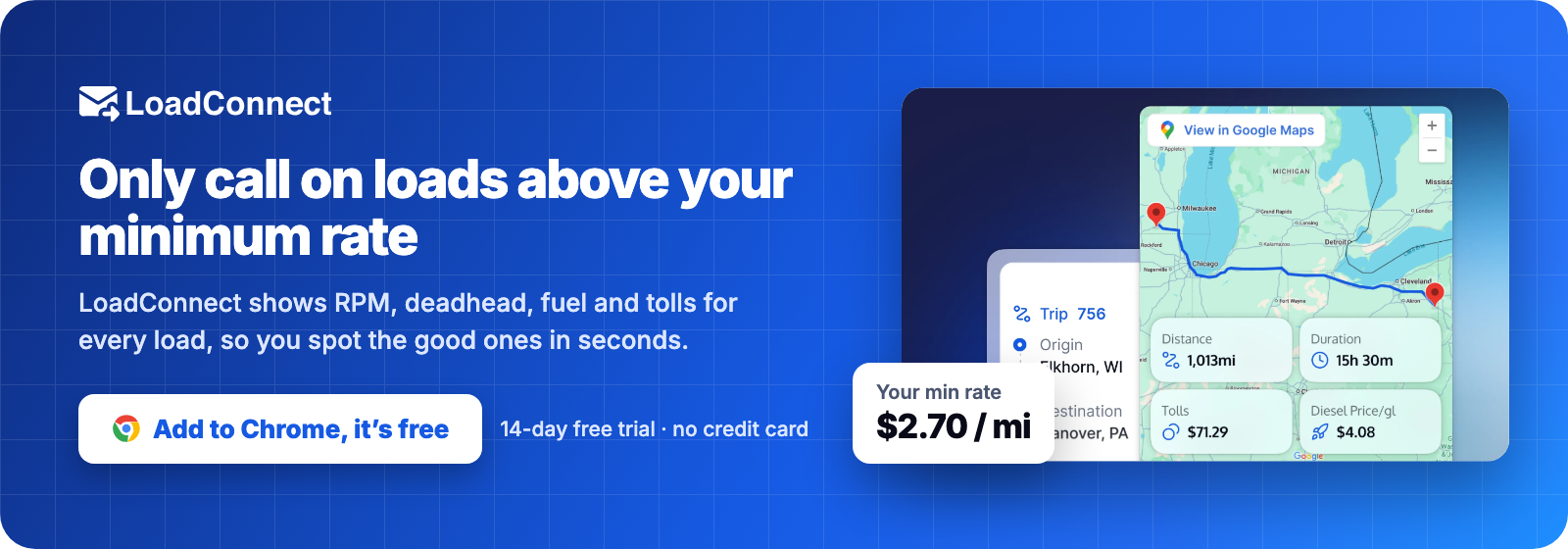
Paid plans start with a 14-day free trial.