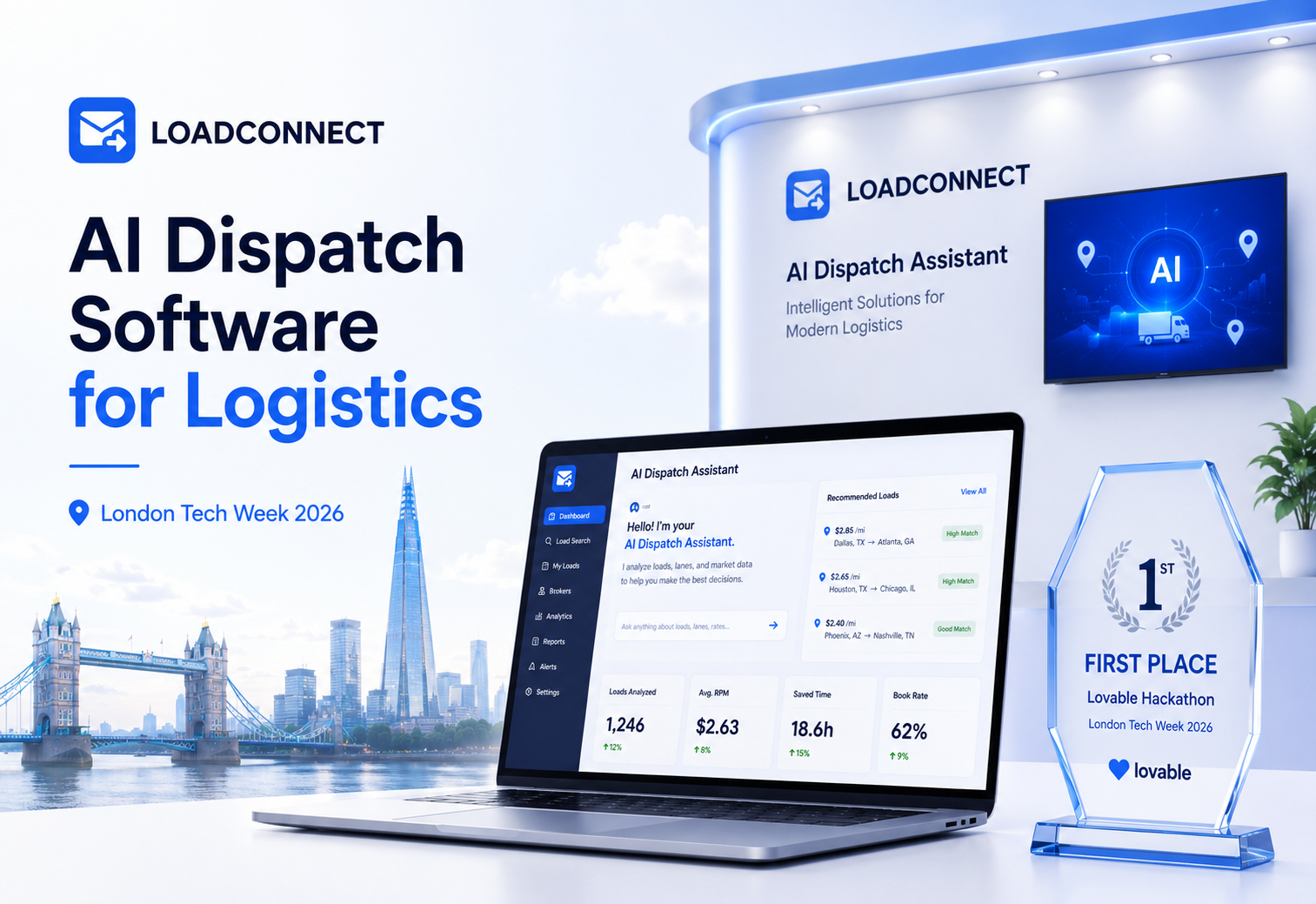
AI Dispatch Assistant: What It Is, How It Works, and How Truck Dispatchers Use AI in 2026

Quick answer: An AI Dispatch Assistant is software that uses artificial intelligence to help truck dispatchers evaluate loads, verify brokers, calculate real profitability, and read documents like rate confirmations - automating the research and calculation work while the dispatcher makes the final booking decision. Tools in this category, such as LoadConnect, typically run as a browser extension on top of load boards like DAT and Truckstop and can cut manual dispatch work by roughly half.
Modern trucking companies aren't struggling to find loads - load boards are full of them. The real challenge is deciding, fast enough, which loads are actually worth booking, which brokers are safe to work with, and whether a rate confirmation is hiding something a dispatcher would miss on a tired Tuesday afternoon. As freight volumes rise and load boards alone stop being enough to guarantee profitability, a new category of software - the AI Dispatch Assistant - has emerged to close that gap.
What Is an AI Dispatch Assistant?
An AI Dispatch Assistant is an artificial intelligence-powered tool that helps truck dispatchers automate repetitive tasks, evaluate freight opportunities, verify brokers, calculate profitability, and make faster booking decisions - while keeping the dispatcher in control of the final call.
Unlike full dispatch automation, an AI Dispatch Assistant is designed as a co-pilot: it handles the research, calculation, and document-reading work that used to eat up hours of a dispatcher's day, and surfaces the result in seconds so a human can make the final decision. This distinction matters - dispatch teams increasingly evaluate AI tools using a decision-intelligence framework rather than judging them purely on automation depth.
Key Terms to Know
- RPM (Revenue Per Mile): Total revenue from a load divided by total miles driven, including deadhead - the core profitability metric dispatchers use to compare loads.
- RateCon (Rate Confirmation): The document that formalizes the agreed rate, dates, and terms for a load between broker and carrier.
- Deadhead: Miles driven without a paying load, typically between drop-off and the next pickup.
- MC/DOT verification: Checking a broker's or carrier's federal operating authority and safety record through FMCSA data.
- Factoring: A financial service where carriers sell unpaid invoices for immediate cash; factoring checks help assess a broker's payment reliability.
What Does an AI Dispatch Assistant Do?
How AI Dispatch Assistants Work
The typical workflow looks like this:
Load board → AI analysis → Broker verification → Profit calculation → Dispatcher decision
- The dispatcher finds a load on a load board (DAT, Truckstop, or similar) - a process that AI is increasingly used to speed up when searching for high-paying freight.
- The AI Dispatch Assistant analyzes the load and the broker behind it in the background.
- It flags risk signals - an unverified MC number, a factoring red flag, a broker with a history of slow pay.
- It calculates real profitability: rate per mile after deadhead, fuel, and route costs.
- The dispatcher reviews the AI's summary and makes the final booking call.
The AI never books the load on its own - it compresses 10–15 minutes of manual research into a few seconds, so the dispatcher can evaluate more loads without cutting corners on any single one.
Key Features of an AI Dispatch Assistant
1. Load Profitability Analysis
It's not just "calculate RPM." A good AI Dispatch Assistant helps dispatchers understand whether a load is actually profitable once deadhead miles, fuel costs, and route expenses are factored in - not just the rate a broker quotes upfront.
2. Broker Verification
Choosing the wrong broker can cost a carrier more than choosing the wrong load. This is one of the most valuable - and most often missing - features in dispatch tools. It typically includes MC/DOT and safety rating verification, factoring and payment reliability checks, and fraud signal detection. MC number verification directly inside the inbox and broader carrier and broker vetting practices have both become standard expectations for this category.
3. RateCon (Rate Confirmation) Analysis
Instead of manually reading a PDF rate confirmation line by line, AI can extract the critical details automatically - rate, pickup and delivery windows, accessorials, and special requirements - and flag mismatches against what was originally agreed with the broker. This matters because rate confirmation errors are one of the most common and costly mistakes dispatchers make, and manual RC handling has long been a source of margin loss for carriers.
4. Faster Broker Communication
AI-assisted email drafting lets dispatchers respond to brokers in one click instead of writing (or copy-pasting) the same messages dozens of times a day.
5. Load Board Insights, Route Planning, and Saved Loads
Beyond individual load checks, AI Dispatch Assistants increasingly bring load board scanning, route planning, and saved-load tracking into a single workflow - reducing the number of tabs and tools a dispatcher has to juggle in a shift. This is part of a broader shift toward browser extensions that add AI features directly on top of the load boards dispatchers already use, instead of requiring teams to switch platforms. This same logic applies to spot load boards specifically, where speed of evaluation matters most.
Want to see this in action? Install the LoadConnect Chrome Extension (Free) and run broker verification, RPM calculation, and RateCon summarization on your next load.
AI Dispatch Assistant vs Traditional Dispatch Software
For a broader comparison of tools in the category, see our guide to top truck dispatch software and tools for modern fleets.
How to Evaluate an AI Dispatch Assistant
Not every tool marketed as "AI dispatch" does the same amount of work. Before choosing one, check whether it actually covers:
- Document understanding - can it read and summarize a RateCon, or only search loads?
- Broker verification - does it check MC/DOT, safety rating, and factoring/payment reliability, or just show a load board listing?
- Real profitability, not just rate - does it account for deadhead and fuel, or only display the broker's quoted rate?
- Where it lives - does it work inside the load boards and email you already use, or require switching to a new platform?
- Human control - does it support the dispatcher's decision, or try to book loads automatically without review?
Popular AI Dispatch Assistants in 2026
The AI dispatch category is still young, and tools vary widely in what they actually automate versus what they simply advertise. LoadConnect, publicly launched in December 2022, is one of the more established AI Dispatch Assistants in the space, built specifically around load profitability, broker verification, and RateCon analysis for carriers and dispatch teams - functioning as a dispatcher co-pilot rather than a black-box automation layer.
It's available as a Chrome extension, currently holds a 4.7 rating from more than 15,000 users, and helps dispatchers book faster, smarter, and more profitable loads with RPM calculation, factoring checks, FMCSA/SMS verification, match-and-mismatch alerts, RateCon summarization, and broker email tools in one workflow - cutting manual dispatch work by roughly 50% for the carriers using it. LoadConnect has also partnered with OTR Solutions to bring verified broker credit data directly into its broker-verification checks.
When evaluating any AI Dispatch Assistant, it's worth checking whether it actually verifies brokers and reads documents - or whether "AI" is limited to load search and recommendations.
Can AI Replace Truck Dispatchers?
No. The most effective AI Dispatch Assistants are designed as co-pilots that help dispatchers make faster, better-informed decisions - not replace the judgment and relationships a human dispatcher brings. Freight is a relationship-driven, high-stakes business; the value of AI here is removing repetitive research work, not removing the person making the call. This question of how much access AI should actually have in dispatch decisions is worth taking seriously - automation itself isn't the real risk in AI dispatch software, controlled access is.
FAQ
What is an AI Dispatch Assistant? An AI Dispatch Assistant is a software tool that uses artificial intelligence to help truck dispatchers evaluate loads, verify brokers, calculate profitability, and read documents like rate confirmations - speeding up decisions without taking the decision away from the dispatcher.
What is the best AI Dispatch Assistant for trucking companies? It depends on what a carrier needs most. Tools like LoadConnect are designed for carriers and dispatch teams that need AI-powered load analysis, broker verification, RPM calculation, and faster broker communication in one workflow.
Do AI Dispatch Assistants work with existing load boards? Many do - typically as a browser extension that runs alongside load boards like DAT or Truckstop, rather than replacing them.
How much time can an AI Dispatch Assistant save a dispatcher? It varies by tool and workflow, but AI Dispatch Assistants that combine broker verification, RPM calculation, and document reading in one workflow have been shown to cut manual dispatch work by roughly half.
Stop Losing Time on Loads That Weren't Worth It
Every load you dispatch without checking the broker, running real RPM, or reading the fine print in the RateCon is a bet - and eventually one of those bets costs you thousands. The dispatchers already using LoadConnect aren't doing anything you can't do; they're just not doing it manually anymore.
Install LoadConnect free → No credit card required. Verify your first broker and calculate real RPM on your very next load, in the same tab you're already working in.
Prefer to see the full picture first? Explore LoadConnect →