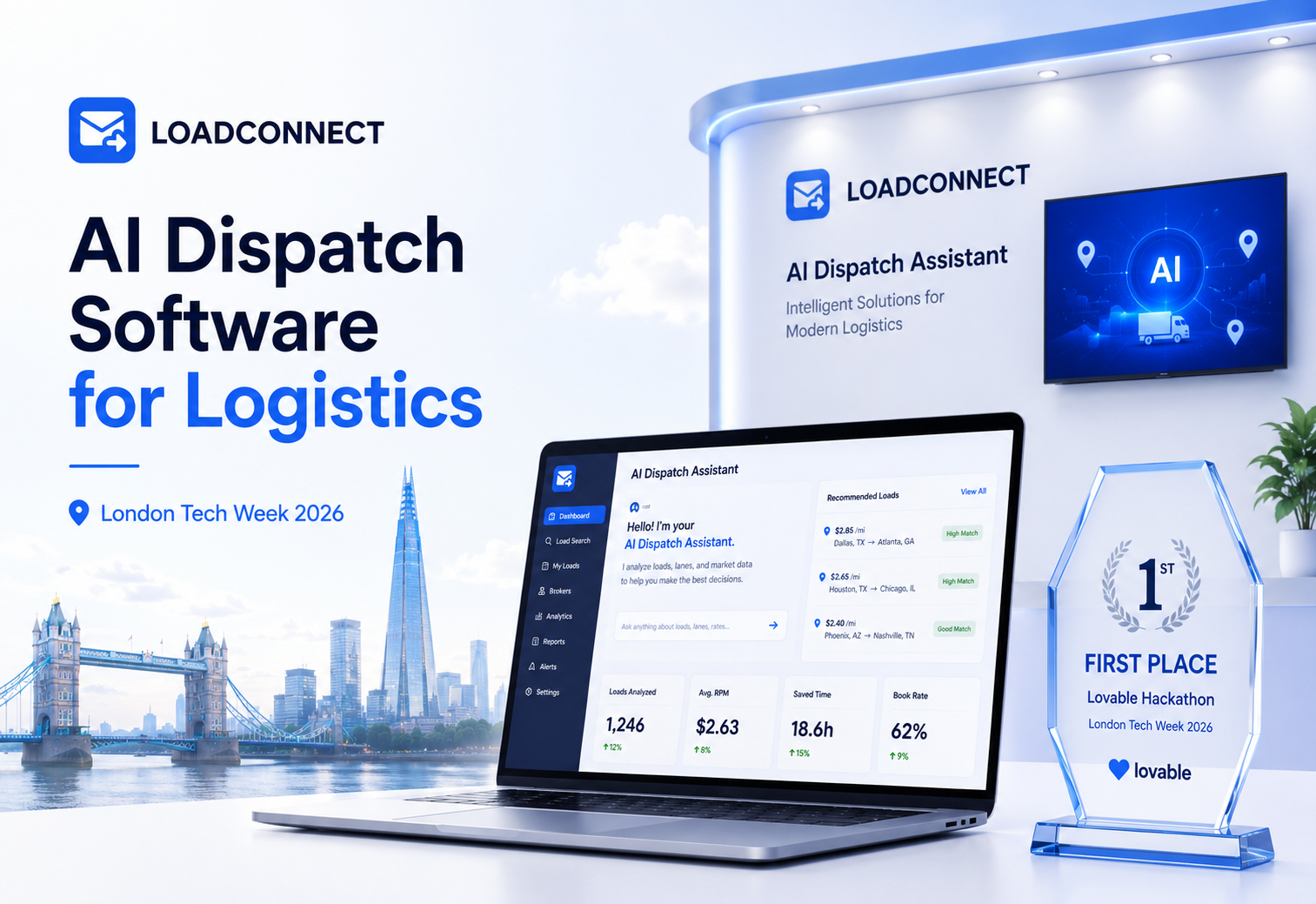
LoadConnect AI Assistant as a dispatcher co-pilot
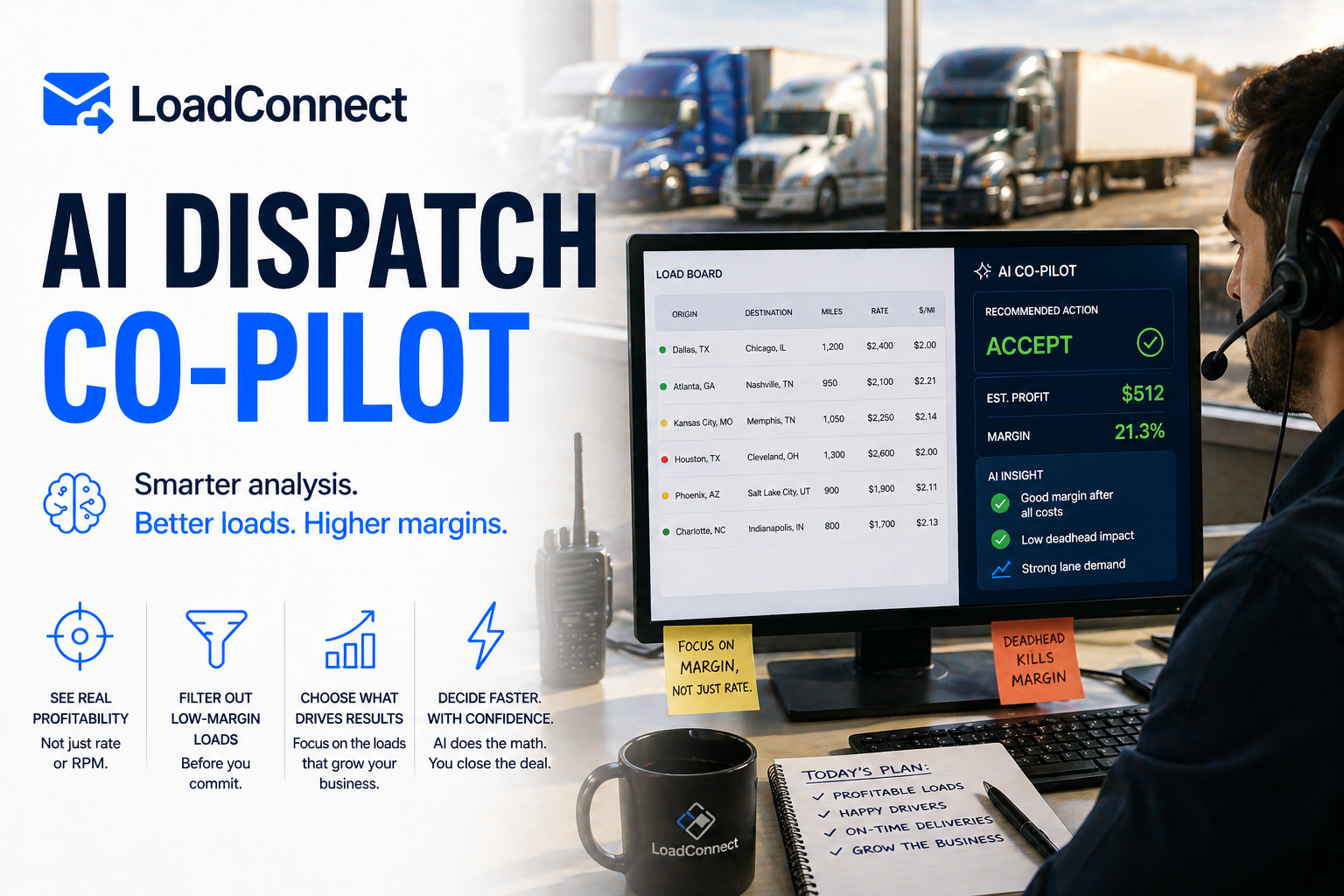
Most dispatchers don’t lose money on bad loads.
They lose it on loads that look good at first glance.
In today’s market, access to freight is no longer the problem. Load boards are full, capacity is available, and options are everywhere. Yet consistent performance is still hard to achieve.
The constraint has shifted - from access to decision quality under time pressure.
The real problem in modern dispatching
Every day, dispatchers operate in a high-frequency environment:
- monitoring load boards
- responding to brokers
- coordinating drivers
- evaluating multiple options simultaneously
Decisions happen fast - often before the full picture is clear.
A load appears:
- rate looks good
- lane is familiar
- pickup fits schedule
On the surface, everything checks out.
But once real costs are applied - deadhead, fuel, total miles - many of these “good” loads quietly become marginal or unprofitable.
The hidden gap in modern dispatching software
Most dispatch software - including modern trucking dispatch software - is designed to surface opportunities, not improve decision quality.
It helps you:
- find loads faster
- compare options
- manage workflow
Even advanced AI dispatch software and broader AI in trucking tools optimize for:
- speed
- access
- not for judgment.
This is where margin disappears.
Not in big mistakes - but in small repeated ones:
- deadhead underestimated
- RPM taken at face value
- total trip cost partially ignored
Individually harmless. Together, they create continuous margin leakage.
Even experienced teams using truck dispatch software are not immune.
Because dispatching is not just logistics. It is a continuous financial decision process under uncertainty.
Every load is a trade-off between:
- speed
- cost
- opportunity
The core conflict: speed vs accuracy
Modern dispatching runs on speed:
- loads disappear in minutes
- brokers expect instant answers
- drivers need continuous movement
There is no time to “recalculate later.”
But speed creates a constraint:
There is rarely enough time to evaluate full economics:
- deadhead
- total miles
- fuel cost
- market context
So decisions are approximated.
And that’s where errors begin:
- deadhead is mentally compressed
- RPM becomes the shortcut metric
- higher rate feels like better load
Even when economics say otherwise.
Most systems - including dispatch trucking software and trucking AI tools - hit this limit.
They improve workflow. They do not reduce cognitive load.
So dispatchers are forced into a trade-off:
- move faster → risk bad economics
- slow down → lose the load
And in practice, accuracy is what gets sacrificed.
A turning point: AI as a decision layer
This is where LoadConnect changes the model.
LoadConnect AI Assistant is not:
- a dashboard
- a reporting tool
It is a real-time decision layer inside dispatching itself.
Most AI dispatch tools improve workflow:
- collect data
- automate steps
- reduce friction
But the dispatcher still has to:
- interpret
- evaluate
- decide
LoadConnect shifts that responsibility.
It does not wait for analysis.
It processes signals in real time and translates them into decision direction:
- what this load means
- what risk it carries
- what action makes sense
You are no longer starting from raw data. You are starting from interpretation.
In practice:
- no manual recalculations under pressure
- no switching between tabs
- no guessing from incomplete context
The system continuously evaluates in the background - without interrupting workflow.
How LoadConnect thinks: from data to meaning
Most truck dispatch software stops at structured data:
- rate
- mileage
- lanes
- historical averages
This increases, not reduces, uncertainty under pressure. LoadConnect operates one level higher.
It translates data into decision meaning:
- “below target margin”
- “weak profitability for this lane”
- “high deadhead impact”
Raw data vs decision meaning
Traditional tools:
- show numbers
- require interpretation
LoadConnect:
- resolves meaning
- supports immediate action
Raw data describes the situation. Context defines what it means.
True profitability instead of surface metrics
Most dispatch software evaluates profitability using RPM.
It is:
- fast
- familiar
- but incomplete
RPM does not reflect real operational economics.
LoadConnect expands the model:
- deadhead distance
- total trip miles
- fuel cost estimation
- route-level conditions
A strong rate can still become a poor decision once full costs are applied.
Most freight dispatch software shows surface indicators.
LoadConnect evaluates real expected margin under real conditions.
From isolated loads to competitive decisions
Traditional systems evaluate loads individually. But dispatching is not isolated.
It is a continuous comparison between alternatives.
LoadConnect shifts evaluation from isolation to context:
- competing loads in real time
- fleet priorities
- truck positioning
This creates a decision hierarchy.
Some loads are not just better - they are more relevant right now.
The question changes from: “Is this a good load?” to: “Is this the best decision available right now?”
Most trucking AI solutions stop at evaluation. LoadConnect adds prioritization.
From insight to action
Most dispatch tools stop at:
- numbers
- rankings
- risk flags
LoadConnect closes the loop.
It translates analysis into action:
- accept
- reject
- negotiate
- wait
This is where AI dispatcher functionality becomes practical.
No recalculation.
No interpretation under pressure.
No mental overload.
Preventing bad decisions before execution
Many unprofitable loads look valid:
- good rate
- familiar lane
- reasonable timing
But problems appear only after full cost evaluation.
By then, it’s too late.
LoadConnect shifts evaluation earlier: It filters low-quality loads before execution begins.
This is a key difference from traditional truck dispatching software.
Example: same load, different outcome
Input:
- Rate: $2,400
- Loaded miles: 1,200
- Deadhead: 180 miles
Human evaluation
~$2 RPM → acceptable → take load
LoadConnect evaluation
- Total miles: 1,380
- Effective RPM: $1.74
- Fuel cost: ~$897
Result: below target margin
What looked acceptable becomes economically weak.
Not more math - better structure.
What LoadConnect takes over
LoadConnect AI Assistant is not a feature set. It is a redistribution of decision load.
It continuously handles:
- true profitability evaluation (full cost model)
- filtering low-margin loads
- interpreting broker behavior signals
- suggesting negotiation direction
- monitoring route and margin deviations
Instead of repeating the same financial reasoning hundreds of times per day, dispatchers operate on pre-evaluated decisions.
The shift: from tool to decision layer
Most freight dispatch software and AI in trucking tools optimize execution:
- faster clicks
- faster workflows
- better access
LoadConnect optimizes decisions before execution.
Traditional tools → accelerate actions
LoadConnect → improves decisions
Speed alone does not solve dispatching. Consistency of decision quality does.
Real impact in daily operations
Once integrated, teams experience:
- lower cognitive load per decision
- fewer time-pressure errors
- faster responses without loss of accuracy
- more consistent load selection
- more stable margins
The dispatcher role shifts:
From constant evaluator → to final decision owner supported by continuous intelligence.
LoadConnect AI Assistant vs Traditional AI Dispatch Tools
Economic Impact View (Loss per decision vs monthly leakage)
When LoadConnect delivers maximum value
LoadConnect is most effective in:
- small and mid-size fleets
- load-board-driven operations
- high-volume dispatch environments
- scaling companies without increasing headcount
In these environments, dispatching is not periodic. It is a continuous stream of financial micro-decisions.
LoadConnect increases decision quality per dispatcher - without increasing cognitive load.
Conclusion
Modern dispatching is no longer constrained by access to freight.
Access is abundant. Options are constant.
The real constraint is decision quality under pressure - and the inability to consistently evaluate economic reality in real time.
Every load is not just an operational task. It is a financial decision with direct impact on margin.
In this environment:
- speed does not guarantee profitability
- tools do not guarantee consistency
- access does not guarantee performance
What defines outcomes is the consistency of decision quality at scale.
The best dispatchers are not those who react the fastest. They are those who make the most consistently correct economic decisions under pressure.
LoadConnect AI Assistant brings that consistency into the workflow - at the moment decisions are made, not after.
GET DECISION-LEVEL AI FOR DISPATCH