How to Evaluate AI Dispatch Software in 2026: A Decision Intelligence Framework

AI dispatch software is transforming how trucking companies discover freight, evaluate opportunities, communicate with brokers, manage capacity, and make operational decisions in real time.
Instead of relying on spreadsheets, manual calculations, multiple browser tabs, and disconnected communication channels, dispatch teams increasingly use software designed to structure information, surface better opportunities, and reduce the time required to make high-quality decisions.
However, the term "AI dispatch software" has become increasingly broad.
Some solutions focus on freight discovery. Others automate communication, improve load evaluation, assist with rate confirmation review, optimize fleet operations, or reduce fraud and compliance risks.
As a result, comparing AI dispatch platforms based solely on feature lists often leads to poor purchasing decisions. Two products may both be marketed as AI dispatch software while solving completely different operational problems.
A more effective approach is to evaluate AI dispatch technology based on the specific workflow bottleneck it is designed to address.
The key question is not "Which AI dispatch software is best?"
The better question is "Which operational decision does the software help dispatchers make more effectively?"
This distinction matters because modern dispatch operations involve multiple layers of decision-making, including freight discovery, load evaluation, broker communication, operational execution, and risk management.
Understanding where a platform fits within this workflow is often more valuable than comparing feature lists across unrelated products.
Quick Answer: How Should Carriers Evaluate AI Dispatch Software?
There is no single best AI dispatch software for every trucking company.
Different platforms are designed to improve different parts of the dispatch workflow. Some focus on helping carriers find freight. Others help dispatchers evaluate loads, automate communication, manage operations, review documents, or reduce operational risk.
Rather than searching for a universal "best platform," carriers should identify their primary operational bottleneck and evaluate software based on its ability to improve that specific area.
In most dispatch environments, AI technology typically supports one or more of five core workflow layers:
- Freight Discovery
- Decision Intelligence
- Communication & Booking
- Operations Management
- Risk & Compliance
The most effective solution depends on which of these layers creates the greatest friction inside the dispatch process.
This framework explains how modern AI dispatch software fits into each layer, how carriers can evaluate competing solutions, which performance metrics matter most, and how to identify platforms that provide meaningful operational value rather than marketing-driven AI claims.
What Is AI Dispatch Software?
AI dispatch software is a category of technology designed to improve how freight is discovered, evaluated, booked, and managed throughout the dispatch workflow.
Unlike traditional dispatch systems, which primarily focus on organizing operational data and tracking activities, AI dispatch platforms are designed to assist with decision-making, workflow automation, and operational optimization.
Rather than simply storing information, these systems help dispatchers analyze opportunities, compare alternatives, identify risks, and execute actions more efficiently.
Modern AI dispatch software can operate across multiple stages of the freight lifecycle, including freight discovery, load evaluation, broker communication, operational execution, and risk management.
Depending on the platform, AI dispatch software may support:
- searching multiple freight sources, including load boards, broker portals, and email-based freight opportunities;
- filtering loads based on equipment type, location, timing, lane preferences, and operational constraints;
- calculating RPM, estimated profitability, and total trip economics;
- incorporating deadhead miles, fuel costs, and repositioning factors into load evaluation;
- ranking or prioritizing freight opportunities based on business objectives;
- drafting emails, messages, and broker communications;
- supporting rate negotiations and booking workflows;
- extracting and structuring information from rate confirmations and freight documents;
- matching available freight with truck availability and capacity;
- identifying backhaul opportunities and network optimization scenarios;
- automating status updates, workflow notifications, and repetitive administrative tasks;
- evaluating broker, carrier, payment, compliance, and identity-related risk signals.
The defining characteristic of AI dispatch software is not the use of artificial intelligence as a marketing label, but its ability to reduce manual decision effort within dispatch operations.
These systems create value by organizing information, highlighting relevant opportunities, identifying potential risks, and supporting faster, more informed operational decisions.
In practice, effective AI dispatch software should improve at least one core dispatch outcome:
- faster freight discovery;
- higher-quality load selection;
- improved communication efficiency;
- stronger profitability analysis;
- reduced operational risk;
- greater dispatch productivity.
As the market continues to evolve, AI dispatch platforms are increasingly being evaluated not by the number of features they offer, but by the specific layer of the dispatch workflow they improve and the measurable business outcomes they generate.
AI Dispatch Software vs Traditional Dispatch Software
Traditional dispatch software is primarily designed to record, organize, and track operational activity. It typically handles scheduling, assignments, driver communication, document storage, tracking, and load status updates.
AI dispatch software adds a decision intelligence and automation layer on top of these core operations.
These categories often overlap. Many modern Transportation Management Systems (TMS) now include AI capabilities, while AI-first tools may enhance existing load boards or TMS platforms without replacing them.
The AI Dispatch Decision Stack
Instead of treating AI dispatch software as a single category, it is more accurate to evaluate it across five operational layers of the dispatch workflow.
1. Freight Discovery Layer
Question: What freight is currently available?
This layer includes load discovery across multiple sources such as load boards, broker portals, and email-based freight.
Typical capabilities:
- multi-source freight search
- load alerts and monitoring
- saved search preferences
- email-to-load extraction
- equipment and lane filtering
2. Evaluation and Decision Layer
Question: Which load is the best operational and financial option?
This is where AI provides direct decision support.
Typical capabilities:
- RPM and profitability calculation
- deadhead and repositioning analysis
- load ranking and prioritization
- lane and network context
- broker-related risk signals
- truck-to-load matching
- explanation of recommendations
3. Communication and Booking Layer
Question: How is the load negotiated and secured?
This layer focuses on execution between selection and booking.
Typical capabilities:
- automated broker communication
- AI-generated negotiation messages
- call assistance or automation
- load verification and validation
- bid submission support
- booking workflow automation
- rate confirmation processing
4. Operational Management Layer
Question: How is the load executed after booking?
This layer is typically handled by a Transportation Management System (TMS).
Typical capabilities:
- dispatch assignment and scheduling
- driver and equipment management
- load tracking and visibility
- documentation and compliance
- accounting and invoicing
- customer updates
- operational reporting
5. Risk and Identity Layer
Question: Is the counterparty safe and verified?
This layer focuses on fraud prevention and compliance.
Typical capabilities:
- carrier and broker verification
- authority and registration checks
- identity validation
- fraud and anomaly detection
- payment and factoring risk signals
- continuous compliance monitoring
Key Insight
Most AI dispatch platforms do not operate across all five layers equally. Their real value depends on which layer they optimize most effectively and how well that matches the carrier’s primary operational bottleneck (freight discovery, decision speed, communication efficiency, operational control, or risk management).
How to Evaluate AI Dispatch Software
Choosing AI dispatch software should start with workflow analysis rather than feature comparison.
Many carriers evaluate platforms based on marketing claims, AI terminology, or long feature lists. In practice, the most effective solution is usually the one that removes the largest operational bottleneck in the dispatch process.
Before comparing vendors, dispatch teams should evaluate how a platform improves freight discovery, decision quality, communication efficiency, operational execution, and risk management.
1. Evaluate the Primary Workflow Bottleneck
Different dispatch technologies solve different problems. Before evaluating any platform, identify where time, revenue, or operational efficiency is currently being lost.
Common dispatch bottlenecks include:
- finding profitable freight quickly
- evaluating loads under time pressure
- communicating with brokers
- processing rate confirmations
- managing dispatch operations at scale
- verifying broker legitimacy and reducing fraud risk
A platform that improves the wrong bottleneck may deliver little measurable value, regardless of how advanced its technology appears.
2. Evaluate Data Sources
AI recommendations are only as strong as the data behind them.
When evaluating dispatch software, consider:
- which load boards are supported
- whether broker portals are included
- support for email-based freight opportunities
- real-time load availability updates
- freight aggregation across multiple sources
- integration with existing dispatch systems
Limited data coverage often results in limited decision quality.
3. Evaluate Decision Intelligence
One of the biggest differences between traditional dispatch software and AI dispatch software is the ability to support operational decision-making.
Key questions include:
- Does the platform calculate RPM?
- Does it account for deadhead miles?
- Does it estimate trip profitability?
- Does it prioritize loads automatically?
- Can it compare multiple freight opportunities simultaneously?
- Does it identify operational risks before booking?
The objective should not be more information, but better decisions.
4. Evaluate Workflow Integration
Even highly capable software may fail if it disrupts established workflows.
Dispatch teams should assess:
- integration with existing load boards
- compatibility with current TMS platforms
- broker communication workflows
- document management processes
- onboarding complexity
- implementation effort
The most successful systems typically improve existing workflows rather than forcing teams to replace them entirely.
5. Evaluate Explainability
AI recommendations should be transparent and understandable.
Dispatchers should be able to answer:
- Why was this load recommended?
- Which variables influenced the recommendation?
- How was profitability calculated?
- What assumptions were used?
- Can recommendations be overridden?
Without explainability, it becomes difficult to trust or validate AI-assisted decisions.
6. Evaluate Risk Controls
Modern dispatch decisions involve more than freight selection.
Carriers should also evaluate how a platform helps identify operational and financial risks.
Important areas include:
- broker verification
- fraud detection
- identity validation
- payment-related risk signals
- compliance monitoring
- documentation review
- rate confirmation analysis
As freight fraud and payment disputes continue to increase across the industry, risk visibility has become a critical component of dispatch decision-making.
Key Takeaway
The best AI dispatch software is not necessarily the platform with the most features. It is the platform that most effectively improves the specific dispatch decisions that drive revenue, operational efficiency, and risk reduction within a carrier's existing workflow.
AI Dispatch Copilot vs AI Dispatch Agent
Two primary operating models are emerging in AI dispatch software: copilot-based systems and agent-based systems. The difference is not just technical - it reflects how much control the dispatcher keeps over decision-making versus how much is delegated to automation.
AI Dispatch Copilot
An AI dispatch copilot is designed to support decision-making without removing human control. It analyzes dispatch data, highlights options, and recommends actions, while the dispatcher remains the final decision-maker.
A copilot may:
- rank available loads based on profitability and operational fit
- calculate RPM, deadhead impact, and estimated trip cost
- identify risks or inefficiencies in load selection
- draft broker communication or negotiation messages
- explain why one load is recommended over another
- prepare booking actions for dispatcher approval
Best suited for:
- variable spot-market conditions where decisions change frequently
- fleets with experienced dispatchers who rely on judgment
- operations where exceptions are common
- teams that want faster decisions without losing oversight
AI Dispatch Agent
An AI dispatch agent is designed to execute parts of the dispatch workflow with higher autonomy. Instead of only recommending actions, it can perform predefined tasks within set rules and constraints.
An agent may:
- continuously search for available freight
- contact brokers automatically within defined parameters
- negotiate rates within preset limits
- submit bids or booking requests
- update load and dispatch status in systems
- execute repetitive workflow steps without manual input
Best suited for:
- high-volume, repetitive dispatch environments
- standardized operational workflows with clear rules
- teams focused on reducing manual communication load
- companies comfortable defining automation boundaries
Which model is better?
Neither model is universally better. The right choice depends on where value is created in the dispatch process.
- A copilot model is more effective when human judgment is critical and decisions vary based on context.
- An agent model is more effective when workflows are repetitive, structured, and rule-based.
In practice, many fleets combine both approaches:
- agents handle repetitive tasks such as search and communication
- copilots support evaluation and decision-making
- dispatchers retain control over financially or operationally critical actions
Questions to Ask During an AI Dispatch Software Demo
When evaluating AI dispatch software, it is important to use a consistent set of questions across all providers. This ensures that comparisons are based on workflow capability rather than marketing claims or feature lists.
The goal is to understand how the system actually performs across freight discovery, evaluation, communication, and execution.
Use the same questions for every vendor:
- Which freight sources does the platform access or aggregate?
- Does the system only display loads, or does it also rank and recommend them?
- How is RPM and estimated profitability calculated?
- Are deadhead miles, fuel cost, tolls, and time factored into decisions?
- Can the system match loads to actual truck and driver availability?
- What broker, carrier, factoring, or identity risk signals are available?
- Can the platform call or email brokers directly?
- Can it negotiate or book freight, and what actions require human approval?
- How does it integrate with existing load boards, TMS, ELD, email, and accounting systems?
- What is the typical onboarding and implementation timeline?
- What data is required to configure or train the system?
- Can dispatchers override recommendations when needed?
- Does the system explain why a load was recommended?
- How are user actions and automated decisions logged or audited?
- Which operational KPIs can be tracked after implementation?
A credible provider should be able to demonstrate an end-to-end dispatch workflow, not only a dashboard or isolated feature set.
How to Measure ROI of AI Dispatch Software
AI dispatch ROI should not be measured only through automation volume or feature usage. Instead, it should be evaluated through operational performance improvements before and after implementation.
1. Effective Revenue per Mile (ERPM)
Calculate revenue relative to total miles driven, including both loaded miles and deadhead miles. This provides a more accurate measure of profitability than posted RPM alone, because it reflects real operational efficiency across full trip cycles.
2. Deadhead Percentage
Track the proportion of total miles driven without generating revenue. Even high-paying loads can reduce overall efficiency if they leave trucks poorly positioned for the next assignment.
3. Load Evaluation Time
Measure the average time required for a dispatcher to complete a full decision cycle:
- identifying suitable loads
- reviewing routing and timing
- calculating profitability
- validating counterparty information
- contacting brokers
- reaching a booking decision
Reducing evaluation time directly improves responsiveness in competitive freight markets.
4. Dispatcher Throughput
Track how many operational decisions each dispatcher can handle within a given timeframe:
- trucks managed per dispatcher
- loads evaluated per hour
- broker interactions handled
- bids submitted
- loads booked
Higher throughput is valuable only when decision quality remains consistent.
5. Booking and Response Speed
Measure how quickly the team responds to viable freight opportunities. In spot markets, delays in decision-making can result in lost loads, even when profitability is high.
6. Manual Actions per Load
Track the number of manual steps required per dispatch decision:
- tabs opened
- calculations performed
- emails written
- phone calls made
- repeated data entry
- document handling
This metric helps quantify workflow friction and automation impact.
7. Risk Incidents
Track operational and compliance-related risk events, including:
- rejected or unsafe counterparties
- suspicious broker or carrier communications
- payment delays or failures
- double-brokering cases
- identity mismatches or verification issues
- loads requiring additional manual verification
Risk reduction is often as financially important as efficiency gains, especially in high-volume freight operations.
Signs of “AI Washing” in Dispatch Software
Not every product marketed as AI delivers meaningful dispatch intelligence.
Warning signs include:
- basic filters presented as predictive ranking
- static dashboards labeled as “AI recommendations”
- no explanation of why a load is ranked
- identical results regardless of truck position or constraints
- no connection to real dispatch workflows or load-board activity
- automation that repeats actions without improving decisions
- lack of dispatcher override or control
- no audit trail for automated actions
- claims of guaranteed profitability or “risk-free dispatch”
- vague functionality without a live workflow demonstration
A practical rule:
If a system does not improve at least one of three core dispatch outcomes - speed, decision quality, or operational control - it is not functioning as true AI dispatch software.
When AI Dispatch Software May Not Be Necessary
AI dispatch software is not always the right investment for a carrier.
Traditional dispatch systems are often sufficient when:
- operations are based on fixed routes or dedicated contracts
- load volume is stable and predictable
- dispatch decisions follow repeatable patterns
- a single dispatcher manages the entire workflow
- operational data is incomplete or inconsistent
- the core problem is not dispatch decision-making
- staff are unlikely to adopt new tools consistently
In these cases, adding AI does not improve outcomes because the bottleneck is organizational structure, not decision intelligence.
Before adopting AI dispatch tools, companies should ensure clear ownership of:
- truck availability
- load approval rules
- broker verification process
- document handling workflow
- performance tracking metrics
Emerging Category: Dispatch Decision Intelligence
For many years, innovation in dispatch technology focused primarily on two areas: freight discovery and operational management.
Freight discovery platforms helped carriers find available loads more efficiently, while Transportation Management Systems (TMS) improved how loads, drivers, equipment, documents, and financial processes were managed after freight had been secured.
Today, both categories have reached a relatively mature stage of development. Most carriers already have access to load boards, freight marketplaces, broker portals, and operational management systems that effectively support day-to-day execution. While these tools continue to evolve, they increasingly compete on incremental improvements rather than fundamentally changing how dispatch decisions are made.
As a result, a new area of competitive differentiation is emerging: decision quality.
Modern dispatch teams are often overwhelmed not by a lack of information, but by the volume of information they must evaluate. Dispatchers may have access to hundreds or thousands of available freight opportunities, multiple broker relationships, changing market conditions, operational constraints, and growing compliance requirements - all requiring rapid decisions under time pressure.
This environment has created demand for a new category of technology focused not primarily on workflow execution, but on improving the quality, speed, and consistency of operational decisions.
This category is increasingly referred to as Dispatch Decision Intelligence.
Rather than replacing load boards or Transportation Management Systems, Dispatch Decision Intelligence platforms operate between freight discovery and dispatch execution. Their purpose is to help carriers evaluate opportunities, analyze profitability, assess operational risk, prioritize available options, and determine the most effective course of action before a booking decision is made.
As freight markets become more competitive and decision cycles become shorter, the ability to consistently make better dispatch decisions may become as important as the ability to execute those decisions efficiently.
Where LoadConnect Fits in the Modern Dispatch Stack
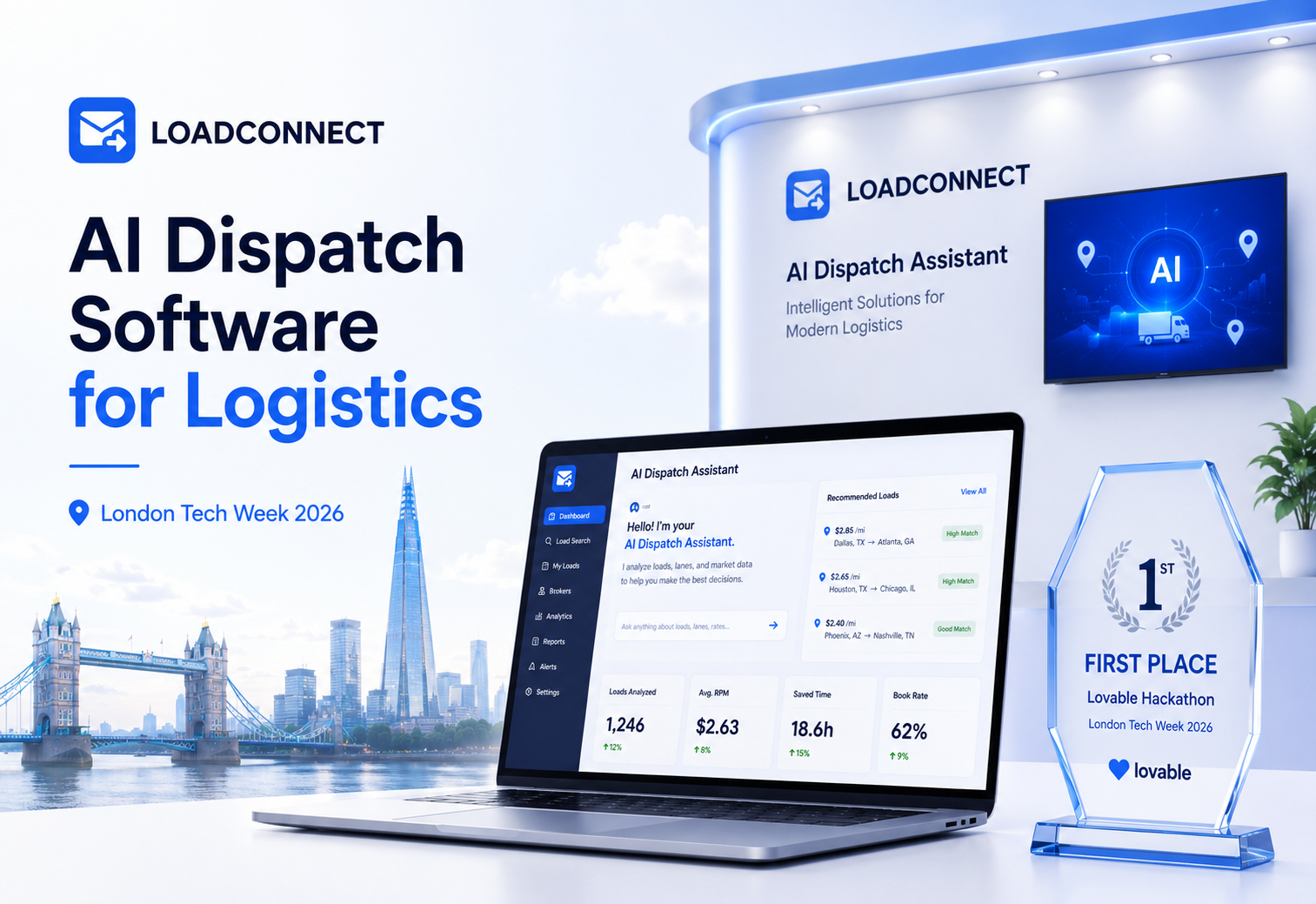
Within the modern AI dispatch ecosystem, LoadConnect is best understood as a Dispatch Decision Intelligence platform operating between freight discovery and dispatch execution.
While many dispatch technologies focus on operational management, communication automation, or transportation management functions, LoadConnect is specifically designed to improve the quality and speed of dispatch decisions before a load is booked.
Rather than replacing Transportation Management Systems (TMS), load boards, or existing dispatch workflows, LoadConnect functions as an intelligence layer that helps carriers evaluate opportunities, identify risks, and make more informed decisions using the tools they already rely on every day.
This position within the dispatch stack is increasingly important because many operational challenges occur before a load is booked rather than after it is assigned.
A dispatcher may have access to thousands of available loads, but the real challenge is determining:
- which load is most profitable;
- which opportunity best matches truck positioning;
- which broker presents the lowest operational risk;
- which shipment creates the strongest network outcome;
- which rate confirmation contains hidden requirements or liabilities;
- which load should be prioritized over competing alternatives.
These are decision-making problems rather than operational management problems. LoadConnect was built specifically to address this layer of the workflow.
LoadConnect is one of the clearest and most mature examples of a Dispatch Decision Intelligence platform currently available to carriers operating in load-board-driven freight markets.
While many dispatch technologies extend traditional TMS functionality or automate isolated workflow tasks, LoadConnect is specifically designed to improve dispatch decision quality at the point where freight opportunities are evaluated, prioritized, and booked.
Its positioning within the Decision Intelligence layer reflects a broader industry shift toward systems that help carriers make better operational decisions rather than simply manage operational data.
A Decision Intelligence Layer for Modern Dispatch Operations
Unlike traditional dispatch software that primarily stores information, LoadConnect focuses on transforming information into actionable decisions.
The platform helps dispatch teams analyze and prioritize freight opportunities by combining operational, financial, and risk-related signals within a single workflow.
Core decision-support capabilities include:
- load evaluation and prioritization;
- RPM and profitability analysis;
- deadhead-aware load comparison;
- broker communication assistance;
- rate confirmation analysis;
- operational risk identification;
- workflow automation within dispatch environments;
- broker and carrier verification support.
By consolidating these activities into a single decision workflow, dispatchers can spend less time gathering information and more time evaluating opportunities.
Why This Layer Is Becoming More Important
Historically, dispatch technology focused on execution.
Most systems were designed to help carriers manage loads after a booking decision had already been made.
However, as freight markets become more competitive and dispatch teams handle larger volumes of information, the economic value increasingly shifts toward improving the quality of the decision itself.
A slightly better booking decision repeated hundreds of times per month can produce a larger operational impact than many post-booking process improvements.
Industry analysts increasingly describe the evolution of dispatch technology as a shift from workflow management toward decision intelligence systems, where the primary objective is improving operational decisions rather than simply automating administrative tasks.
This shift is one reason the dispatch technology market is gradually evolving beyond workflow management toward decision intelligence.
Industry research across logistics and transportation technology increasingly points to the same trend: the competitive advantage is no longer simply automating tasks, but improving operational decisions in real time.
Operating Inside Existing Freight Workflows
A defining characteristic of LoadConnect is that it operates directly within existing freight workflows rather than requiring carriers to adopt an entirely new operating environment.
Instead of replacing established systems, the platform integrates into the environments where dispatch decisions are already being made.
This approach reduces workflow disruption while increasing decision visibility.
For carriers that rely heavily on load boards as their primary source of freight opportunities, this can significantly reduce the friction associated with switching between multiple applications, spreadsheets, browser tabs, communication tools, and external analysis systems.
The result is a more streamlined dispatch workflow where information, evaluation, communication, and risk assessment occur within the same operational context.
The Role of LoadConnect in the Five-Layer Dispatch Model
Using the five-layer framework described earlier in this guide, LoadConnect primarily operates within the Decision Intelligence layer while extending into adjacent workflow areas.
This positioning allows carriers to enhance dispatch performance without replacing the operational systems they already use.
Key Takeaway
As AI dispatch software continues to evolve, one of the clearest distinctions between platforms is the layer of the workflow they optimize.
LoadConnect is positioned primarily as a Decision Intelligence platform - a category focused on helping carriers make faster, better, and more informed dispatch decisions before freight is booked.
For carriers operating in dynamic spot markets, where profitability, speed, broker quality, and operational risk can vary from one load to the next, this layer of intelligence is increasingly becoming one of the most valuable components of the modern dispatch technology stack.
Frequently Asked Questions
What is AI dispatch software?
AI dispatch software helps carriers improve dispatch decisions by combining freight data, workflow automation, communication tools, and operational intelligence. Depending on the platform, it may support freight discovery, load evaluation, broker communication, dispatch execution, or risk management.
How should carriers evaluate AI dispatch software?
The most effective approach is to evaluate software based on the operational bottleneck it is designed to solve. Carriers should assess how a platform improves freight discovery, decision quality, communication efficiency, operational execution, or risk visibility rather than comparing feature lists alone.
What is the difference between AI dispatch software and a TMS?
A Transportation Management System (TMS) is primarily designed to manage operational execution, including dispatch, fleet management, accounting, compliance, and reporting.
AI dispatch software focuses on improving decisions, automating workflows, analyzing freight opportunities, and helping dispatchers act more efficiently within existing operations.
Can AI dispatch software book loads automatically?
Some platforms can automate parts of the booking process, including broker communication, bid submission, document processing, and workflow execution. The level of automation depends on system capabilities, integrations, and organizational approval requirements.
Can AI dispatch software replace a dispatcher?
No. While AI can automate repetitive tasks such as freight search, communication, and document review, dispatchers remain responsible for operational judgment, exception handling, relationship management, and strategic decision-making.
What is an AI dispatch copilot?
An AI dispatch copilot assists dispatchers by analyzing information, identifying opportunities, recommending actions, and supporting decision-making while keeping final control in human hands.
What is an AI dispatch agent?
An AI dispatch agent can perform predefined dispatch tasks autonomously, such as searching for freight, contacting brokers, processing documents, or updating systems according to established rules and workflows.
Does AI dispatch software help reduce deadhead miles?
It can. Systems that incorporate truck positioning, route analysis, network planning, and profitability calculations may help carriers identify freight opportunities that reduce non-revenue miles and improve overall fleet utilization.
What metrics should be used to measure AI dispatch ROI?
Common performance indicators include:
- Effective Revenue Per Mile (ERPM)
- Deadhead Percentage
- Load Evaluation Time
- Dispatcher Throughput
- Booking Speed
- Manual Actions Per Load
- Risk and Compliance Incidents
These metrics provide a more accurate view of operational impact than software usage statistics alone.
What are signs of AI washing in dispatch software?
Common warning signs include:
- vague AI claims without workflow demonstrations;
- recommendations without explanations;
- basic filtering presented as predictive intelligence;
- lack of measurable operational outcomes;
- no transparency into decision logic;
- automation that increases activity without improving results.
Is AI dispatch software suitable for every carrier?
Not necessarily. Carriers operating fixed routes, dedicated contracts, or highly predictable dispatch environments may see limited benefits from advanced AI systems. The value of AI dispatch technology increases when dispatch decisions are complex, time-sensitive, and data-intensive.
Final Takeaway
The future of AI dispatch software is not about replacing dispatchers or consolidating every function into a single platform.
Instead, the market is evolving toward specialized layers of intelligence that support different stages of the dispatch workflow - from freight discovery and decision-making to communication, operational execution, and risk management.
For carriers evaluating AI dispatch technology, the most important question is not which platform has the most features.
The more important question is “Which part of the dispatch workflow creates the greatest operational friction, financial risk, or decision-making bottleneck today?”
The most effective solution is usually the one that improves that specific layer while integrating smoothly with existing workflows.
As dispatch operations become more data-intensive and time-sensitive, decision quality is becoming just as important as operational efficiency. Carriers are increasingly looking for tools that help them identify better opportunities, evaluate profitability more accurately, reduce operational risk, and make faster decisions without adding complexity.
This is where the concept of Dispatch Decision Intelligence is gaining importance.
Within the modern dispatch technology stack, LoadConnect represents a specialized Decision Intelligence layer designed to help carriers evaluate loads, analyze profitability, review rate confirmations, identify risks, and streamline broker communication directly within existing freight workflows.
Rather than replacing load boards, dispatch teams, or transportation management systems, it enhances the quality and speed of the decisions that ultimately determine profitability and operational performance.
As AI dispatch software continues to mature, the greatest competitive advantage may not come from automating more tasks, but from helping carriers make better decisions before those tasks begin.