
How to Negotiate Freight Rates: For Carriers & Dispatchers

Quick answer: This guide is for owner-operators, small carriers and truck dispatchers who book spot loads from brokers on DAT or Truckstop. Here is how to negotiate freight rates, step by step: know the lowest price your truck can take, check what the lane pays this week, ask about the load, then counter with one number and one reason. If the broker can't get close, pass politely. Whatever you agree on, get it written on the rate confirmation. Below: each step, a call script, an email version and a checklist.
Who this is for
You run one truck or a small fleet, or you dispatch for a few carriers. You find a load on the board, call or email the broker, and agree on a price in a few minutes. The broker does this all day. You do it a few times a week.
That's fine. Brokers expect a counter, and the posted price is where the talk starts. The carriers who earn well are not the loudest on the phone. They know their numbers and they are easy to work with.
Step 1: Know your minimum before you call
Your minimum is the lowest price at which a load still pays for itself. To get it, you need to know what each mile costs you: fuel, truck payment, insurance, repairs, driver pay and the rest, divided by the miles you run in a month. Our rate playbook shows how to work it out.
For scale, ATRI's cost report puts the 2025 industry average at about $2.34 per mile with fuel. Your truck may be higher or lower, so use your own number.
One simple example. Your truck costs $2.00 a mile. The load is 500 miles, and the pickup is 50 miles away empty.
- You will drive 550 miles. 550 × $2.00 = $1,100. That is your minimum.
- Add the profit you want for the day, say $300: $1,400. That is your target.
- Ask a bit higher so you have room to give: $1,500.
The broker posts it at $1,200. It covers your costs, but leaves only $100. Now you have a reason to counter.
Spot prices are "all-in", with fuel inside. OOIDA notes that brokers usually don't pay a separate fuel surcharge, so your minimum must cover fuel too.
Step 2: Check what the lane pays this week
Look up the recent average for the lane on your load board. Then read the signs:
- Lots of loads, few trucks on the lane: you can ask more.
- Lots of trucks, few loads: expect less room.
- The load has sat on the board for hours or was reposted: the broker is struggling to cover it.
- Friday afternoon or late in the day: brokers want loads covered before they go home.
- Pickup today: a truck that is ready now is worth more.
Only quote a market number you have actually seen. Brokers look at the same screens.
Step 3: Ask about the load before you talk money
A price only makes sense once you know the whole job. Ask:
- Weight and commodity? Full or partial?
- Pickup and delivery times. Appointment or first come, first served?
- How many stops? Live load or drop trailer?
- Who pays the lumper?
- What is detention pay, and after how many hours?
- Is there TONU (truck ordered, not used) if they cancel?
- How fast do you pay?
The answers often give you the reason to counter: an extra stop, a slow receiver, a tight appointment. They also protect you. ATRI found that in 2023 trucks were held over two hours at 39.3% of stops, so detention terms matter.
Step 4: Counter with one number and one reason
Don't just say "can you do better?" Give a number and a short reason, then stop talking and let the broker answer.
- "I'm 50 miles out empty. I can do it for $1,500."
- "It has two stops. I need $1,450 to make it work."
- "The board shows this lane around $2.90 a mile this week. Can you get me to $1,450?"
If the broker comes back lower, meet in the middle once, as long as you stay above your minimum. One or two rounds is normal. After that, the broker is likely at their limit.
Step 5: Walk away politely when it's below your minimum
If the last offer is under your minimum, say no without burning the bridge:
"I can't make that one work with my costs. If anything changes, call me."
Loads often come back an hour later at a better price because nobody took them. And if you keep hauling below cost, brokers learn that you will.
Step 6: Get it on the rate con
A phone deal only counts once it's written down. Read the rate confirmation and check the rate, stops, times, detention, TONU and lumper. If anything differs from the call, ask the broker to fix it before the truck moves. Here are the most common rate confirmation mistakes.
Check the broker too: their authority and how fast they pay. A great rate is worth nothing if it arrives in 60 days, or never. Our guide to broker fraud and the free carrier lookup help here.
Freight rate negotiation call script
You: Hi, this is Sam with Blue Road Transport, MC 123456. Calling about your Columbus to Nashville load for tomorrow.
Broker: Sure. 38,000 pounds of paper, one stop, pickup 8 a.m., delivery next morning.
You: Is it live load? Who pays the lumper, and what's your detention?
Broker: Live, no lumper. Detention is $50 an hour after two hours.
You: What's the best you can do?
Broker: $1,200.
You: I'm 50 miles out empty, so that's low for me. I can do it for $1,500.
Broker: I can go $1,350.
You: Meet me at $1,425 and I'll send my packet now.
Broker: Okay, $1,425.
You: Great. Please put the $1,425 and the detention on the rate con.
Names, lane and numbers are made up. Keep the order: who you are, questions, their price, your number with a reason, then the rate con.
How to negotiate freight rates by email
Dispatchers working several trucks often email first and call after. Keep it short:
Hi, I have a 53' dry van empty near Columbus, ready tomorrow morning, for your Nashville load (ref 4521). Can you confirm weight, appointment times and detention? I can do it for $1,500. Thanks, Sam, Blue Road Transport, MC 123456.
Build relationships with brokers
The easiest rates to get come from brokers who already trust you. Pick up on time, answer the phone, send updates before they ask, and send paperwork right after delivery. After a few good loads, ask which lanes they run every week. Brokers call trusted carriers before they post a load, and those calls go easier.
Where LoadConnect helps
LoadConnect is a Chrome extension that works inside DAT, Truckstop, Sylectus and Loadlink. It doesn't call brokers or book loads. It puts the facts next to each load, so you go into the call ready:
- Rate per mile and driver pay on every load.
- Broker check next to the load: is the authority active (FMCSA), and how quickly does this broker usually pay (OTR Solutions score).
- Send your email template to the broker in one click; the load details fill in for you.
- Rate con summary in Gmail, so you can match it against the call.
That's our idea of an AI dispatch assistant: it does the checks, you do the talking.
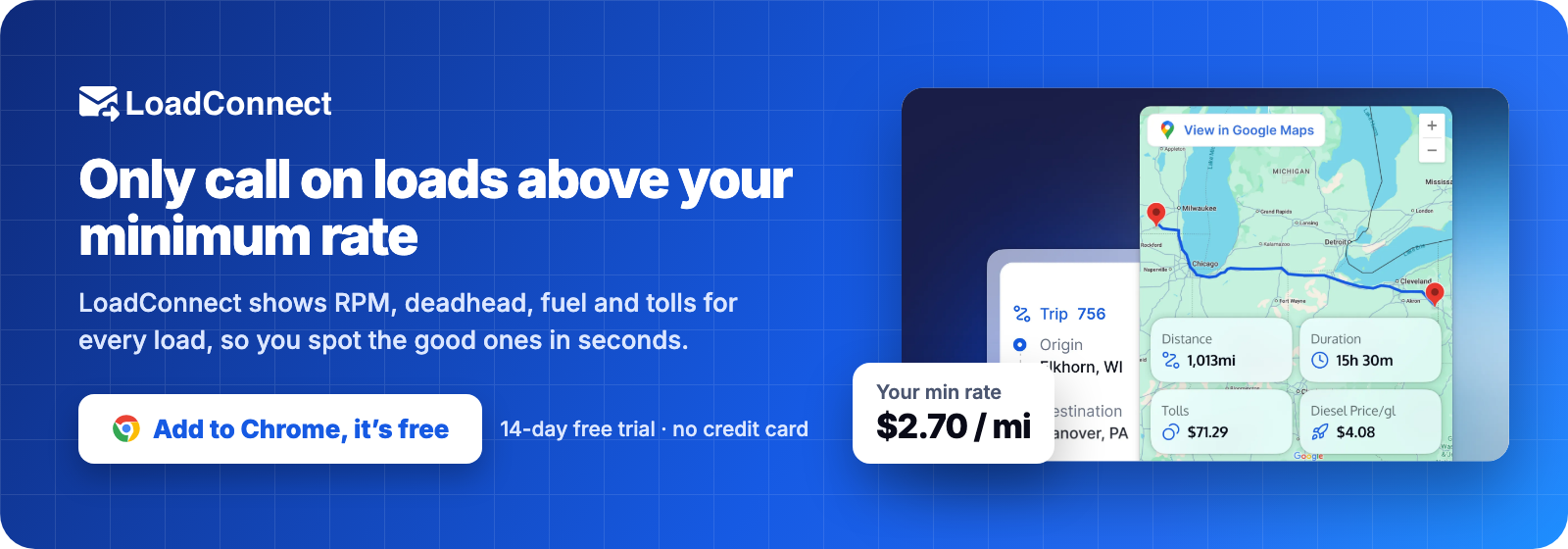
Paid plans start with a 14-day free trial.
Checklist before you book
- ☐ I know my minimum for this load, empty miles included.
- ☐ I checked what the lane pays this week.
- ☐ I asked about weight, times, stops, lumper, detention, TONU and payment.
- ☐ I countered with one number and one reason.
- ☐ I did not go below my minimum.
- ☐ I checked the broker's authority and days to pay.
- ☐ The rate con matches the call.


