
Layover Pay in Trucking: A Guide for Carriers & Dispatchers

Quick answer: Layover pay in trucking is a flat daily fee a carrier collects when the dock can't load or unload the truck on the planned day and the truck has to wait overnight. We wrote this for owner-operators and small fleets that take loads from brokers, and for the dispatchers who book for them. Brokers that publish their rates pay about $150 to $250 per day, usually well below what a truck brings in on a working day. Nobody adds it for you: layover is paid when it was agreed, written on the rate confirmation and backed by proof. Below: what brokers pay, six steps to collect it, and a message you can copy.
What is layover pay in trucking?
A layover is a lost day. The truck arrived for its appointment, the facility could not handle it that day, and the driver was told to come back tomorrow or later. Layover pay is the fee for that day, usually one flat amount and not an hourly rate.
Who pays depends on how you work:
- You run under your own authority. The broker pays you, by the terms on the rate con.
- You are a company driver or leased on to a carrier. Your carrier pays you by its own pay policy.
- You dispatch for carriers. You settle the layover terms with the broker before booking and chase the paperwork afterward.
This guide is about the first and third cases: the money between broker and carrier.
Layover is a contract term. Federal hours-of-service rules set how long a driver may drive, and they are silent on what a wait is worth. The rate and the start time are whatever you and the broker put in writing.
Layover vs detention pay (and TONU)
Three charges get mixed up all the time:
- Detention is hourly. It starts after the free time at a stop, most often two hours, and published broker schedules cap it at a few hours.
- Layover is daily. It takes over when the wait runs past the detention cap or into the next day.
- TONU (truck ordered, not used) is a one-time fee when the load is cancelled after the truck was already sent.
Plan on getting detention or layover for the same wait, not both. Uber Freight's carrier accessorial policy says carriers can't collect both for one stop and one time period, and J.B. Hunt's schedule has the same rule.
How much is layover pay for owner-operators?
No single number exists. Here is what three companies publish:
- J.B. Hunt (Carrier 360 accessorials): $250 per day when the load is tracked with automated updates, $150 per day when times are recorded by hand. Detention stops at five hours; past that, the charge becomes a layover. The schedule was posted in 2020, so read your load tender for current figures.
- Uber Freight: $200 per day. Detention is $40 an hour, five hours at most.
- ATS, a large carrier, tells its shipper customers to expect a layover fee of no less than $250 to $300 on a standard dry van or flatbed load.
So $150 to $300 a day is a range you can point to on an ordinary load. Smaller brokers set their own figure, or have none until you ask.
One simple example. Say your truck brings in about $1,000 on a normal working day. The receiver can't unload you on Wednesday and tells you to come back Thursday morning. You lost one day.
- With $250 layover on the rate con, you bill $250. You are still $750 short.
- With nothing on the rate con, you bill $0 and can only ask for a favor.
Layover softens a lost day. It doesn't replace one. So bring it up while you are still agreeing on the price, as in our guide on how to negotiate freight rates.
When does layover pay start?
That depends on the paper. Three triggers are common:
- The wait passes the detention cap. In J.B. Hunt's schedule, that is after five hours of detention.
- The truck has to stay overnight because the dock can't take it on the appointment day.
- A full 24 hours of delay. Some policies, mostly carriers' own driver pay rules, count a layover only then.
Ask which one applies. "Layover $200" with no start time invites an argument later.
Why reefers and holiday weeks need extra care
Long waits are common, and reefers get the worst of them. An ATRI study found that in 2023 drivers sat for more than two hours at roughly four stops in ten (39.3%). For refrigerated trailers the figure was 56.2%. ATRI also found that nearly all fleets (94.5%) bill for detention, yet under half of those invoices get paid. A claim that was never written down is the easiest one to refuse.
Thanksgiving week shows the risk. This year the holiday is Thursday, Nov. 26. DAT's latest produce report says trucks are tight: on USDA's scale, 55 of 76 produce lanes show a shortage or slight shortage. Rates look good, but if a Wednesday delivery slips and the receiver is closed Thursday, the truck sits through the holiday. Before you book a load that delivers Nov. 25 to 27, ask for the receiver's holiday hours and what the broker pays if the truck isn't unloaded on time. Heading for produce? Run our reefer lanes math first.
How to get layover pay: 6 steps
Step 1: Ask before you book
"What is your layover, and when does it start?" Then two more: is detention paid on top of it or instead of it, and what proof do you need?
Step 2: Put the terms in writing
You want the amount per day and the trigger on the rate confirmation. If it is silent, email the broker and ask for the line before the truck rolls. Missing accessorial terms are high on our list of rate confirmation mistakes.
Step 3: Be on time and keep tracking on
Uber Freight pays accessorials only to carriers that arrive on time for the appointment. J.B. Hunt pays $100 more per layover day on loads with automated tracking.
Step 4: Report the delay right away
When the dock says "not today", call the broker, then send an email with the time and the new appointment. Uber Freight tells carriers to call immediately if a facility says the load won't be ready that day.
Step 5: Get arrival and departure times signed
Have the facility sign the bill of lading with the time the truck came in and the time it left. Uber Freight requires this on every load, and if the facility won't write the times, the driver should write them in.
Step 6: Request it fast and get a revised rate con
Brokers set deadlines. Uber Freight wants detention requests within 24 hours of delivery. Ask for an updated rate confirmation that shows the layover line, then invoice.
What to say: call script and email
Before booking:
You: One question before I book. What's your layover if the receiver can't unload us on the appointment day?
Broker: $150 a day.
You: With the holiday, the truck could sit two days. I need $250 a day, starting if we're not unloaded by end of day on the appointment date. Can you put that on the rate con?
Broker: I can do $200.
You: Okay, $200 a day, in writing. Send it over.
When the delay starts:
Hi Dana, load 7730. Driver checked in at 9:40 a.m. for the 10:00 appointment. At 3:15 p.m. the receiver said they can't unload today and gave us 6:00 a.m. tomorrow. Please confirm layover of $200 per the rate con and send a revised rate confirmation. Check-in photo attached. Thanks, Alex, Ridgeline Freight, MC 000000.
The people, the load and the dollar amounts are invented. Keep the content: load number, times, what the facility said, what you are asking for.
When layover won't be paid
- The truck was late for the appointment.
- The delay came from your side: a breakdown, the driver out of hours, the wrong equipment.
- Nothing was written down, and the broker has no standard policy.
- You can't show the times, or you asked after the broker's deadline.
- You billed detention and layover for the same hours.
A broker who refuses to put any layover on the rate con before a holiday is telling you how a claim would go.
Where LoadConnect fits in
LoadConnect runs as a Chrome extension on top of the load boards you already use (DAT, Truckstop, Sylectus, Loadlink). It won't phone the broker or file a layover claim. Its job is to show you the facts before you commit a truck:
- RPM and driver pay for every load, so you know what it is worth before a lost day gets added.
- Broker check beside the load: FMCSA authority status, the OTR Solutions score and how many days the broker takes to pay. A broker that is slow on the linehaul won't be quick with a layover payment. Our broker fraud guide lists other red flags.
- Rate con summary in Gmail, a short view of the key terms to compare with your notes from the call.
- Warnings on suspicious emails.
That is how we see an AI dispatch assistant: it prepares the numbers and the checks, and the dispatcher decides.
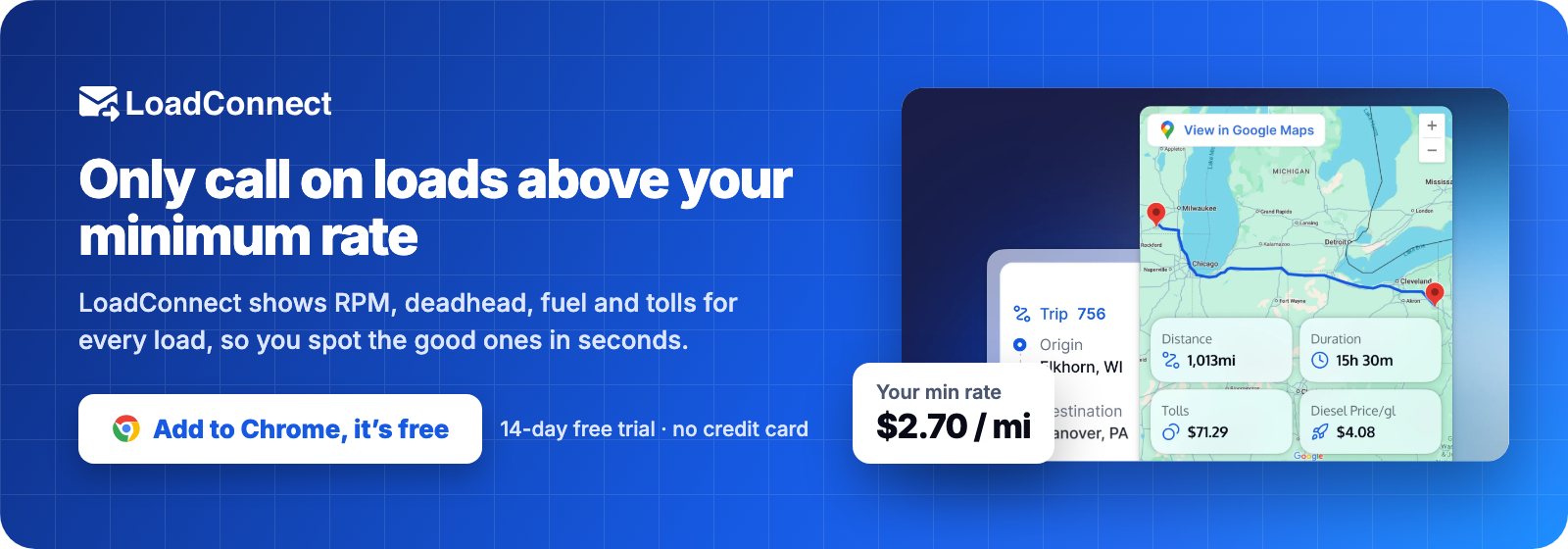
Paid plans start with a 14-day free trial.
Layover checklist
- ☐ I asked the broker for the layover amount and when it starts.
- ☐ The rate con shows both.
- ☐ I checked the receiver's hours for holidays and weekends.
- ☐ Tracking is on and the truck is on time.
- ☐ The BOL has signed arrival and departure times.
- ☐ I asked for a revised rate con before the deadline.


